2026-27 South Glens Falls High School Academic Program Guide
Honors And College Credit Opportunities
Honors/Accelerated Courses
This is a rigorous and demanding level of coursework and includes enriched and accelerated-level work. Enrichment beyond the equivalent Regents-level starts in eighth grade with accelerated classes and honors in high school.
Advanced Placement (AP)
Advanced Placement courses allow students to gain college credit based upon the results of a national comprehensive examination provided by the College Board. They are taught at a college-level, and there is a fee associated with the course.
AP Biology
AP Chemistry
AP Computer Science A
AP Computer Science Principles
AP Drawing
AP Language & Composition
AP Literature & Composition
AP Psychology
AP United States Government & Politics
AP United States History
AP World History: Modern
AP 2-D Art and Design
Self-Selection
The high school has an open enrollment policy regarding honors, AP or other college-level courses. Teachers and counselors are available to discuss questions regarding course expectations and recommended preparation. However, students and parents should be advised that once a student has signed up for an upper-level course, there is no assurance that a request for a level change can be accommodated.
For example, moving from an advanced-placement course to a Regents-level course may not be possible, given a student's schedule. Students are urged to make use of advanced planning and exploration strategies when self-selecting for an honors, AP or other college-level courses.
International Baccalaureate (Ib)
The International Baccalaureate Diploma Programme is an academically challenging program that prepares students for success at the university level and beyond.
Students who complete all aspects of the program will receive an IB Diploma Certificate.
Agreements With Specific Colleges
SGFHS also has agreements with several colleges that will grant credit hours for specific courses. Students who successfully complete the coursework and pay tuition will earn a number of college credit hours to add to their credentials. Many times, other colleges will accept these credits as well.
SUNY Adirondack Business Communications
SUNY Adirondack Calculus I
SUNY Adirondack Calculus II
SUNY Adirondack Introduction to
Personal Economics
SUNY Adirondack Introduction to
College Writing
SUNY Adirondack Principles of
Management
SUNY Adirondack Principles of Marketing
SUNY Adirondack Writing In and About Literature
SUNY Albany French IV
SUNY Albany French V
SUNY Albany Spanish IV
SUNY Albany Spanish V
SUPA Forensic Chemistry
RIT Introduction to Engineering Design
RIT Engineering Design & Development
RIT Principles of Engineering
RIT Computer Integrated Manufacturing
RIT Civil Engineering & Architecture
ECHS Clean Technologies & Sustainable Industries (Hudson Valley Community College)
ECHS Clean Energy
ECHS Community and Public Health
ECHS Engineering Sciences
ECHS Entrepreneurship
ECHS Hacking/Cybersecurity
ECHS Polysomnography
ECHS Surgical Technology
ECCA Advanced Manufacturing
(SUNY Adirondack)
ECCA Business Entrepreneurship
(SUNY Adirondack)
ECCA IT Computer Networking
(SUNY Adirondack)
ECCA New Media (SUNY Adirondack)
ECCA Pathways to Teaching (SUNY Adirondack
Course Fees
Throughout this book, there are several notes indicating that a particular course has a required fee associated with it, such as for an Advanced Placement exam. Students who enroll in Advanced Placement courses are required to take the AP exam, and are expected to pay the associated exam fee for each exam. The 2026-27 fees* are expected as follows:
AP Exams- $98 per exam
SUNY Courses- $80 per credit hour
RIT Courses- $240
SUPA - $115
If a student is not able to meet the fee requirement for any college-level course, he or she is urged to contact a school counselor or administrator to arrange for a fee waiver.
*Fees determined by the agencies involved.
Important Considerations And School Policies
Course Load Requirements
It is expected that all students will register for an academic program requiring full-time attendance in school. Therefore, students must enroll in a minimum of five courses each semester, as well as physical education.
Promotion And Retention Policy
GRADE LEVEL | UNITS OF CREDIT REQUIRED |
Grade 9/Freshman | Promotion from grade 8. |
Grade 10/Sophomore | Students have earned 4.5 cumulative credits including 1 unit of English or social studies. |
Grade 11/Junior | Students have earned 9 cumulative credits including a combination of 3 units of English/social studies, 1 unit of mathematics and 1 unit of science. |
Grade 12/Senior | Students have earned 15 cumulative credits including a combination of 4.5 units of English/social studies, 2 units of math, 1 unit of science. Additionally, the student must be enrolled in all courses that are required for him or her to graduate in June. |
Students are encouraged to maintain a rigorous academic program. However, in the event that a student desires to drop a course, he or she must first make an appointment to speak with his/her school counselor. During this meeting, the following items will be discussed:
Coursework completed to date;
The number of times the student has sought extra-help;
The reason why the student wants to drop the course;
Appropriateness and consequences of dropping the course.
Following the meeting, students may be asked to complete the dropped course form, which includes approval of the student, parent/guardian and teacher.
NOTE: It is expected that all students will register for an academic program requiring full-time attendance in school. Therefore, students must enroll in a minimum of five courses each semester. Additionally, all students must enroll in physical education each semester.
Course Level Adjustment Deadlines
Add a semester course: Within the first 2 weeks of the semester
Add a full-year course: Within the first 3 weeks of the school year
Drop a semester course: Within the first 5 weeks of the semester
Drop a full-year course: Within the first 10 weeks of the school year
Level Adjustment: Within the first 10 weeks of the school year
Grading System
South Glens Falls high school uses transcripts that allow for communication of student performance with both an unweighted and a weighted grade point average (GPA). SGF recognizes courses that culminate in the potential for college credit (e.g. Advanced Placement, SUPA, PLTW, ECHS, etc.) with a “weighting factor” of 2.
The district utilizes the Latin Honors System (i.e. Summa Cum Laude, Magna Cum Laude, Cum Laude) that recognizes students for their academic excellence. The overall GPA designations for these honors align with our existing academic recognition benchmarks. Any student who has reached the required high school GPA (calculated at the end of the third quarter of senior year) will be recognized at graduation. These levels are as follows:
Summa Cum Laude: 95 to 100
Magna Cum Laude: 90 to 94.9
Cum Laude: 85 to 89.9
Report Card Grades
Per the board policy of the South Glens Falls CSD Board of Education, students can not earn less than a 50 percent or an F as a representation of a quarterly grade.
Appeals Process
The Board of Regents approved an appeals process for students who have scored within five points of 65 (60-64) on a required Regents exam for graduation and have a 65 course average. An appeal may be initiated by a student or by the student's parent/guardian or teacher on his/her behalf.
In order to appeal, the following criteria must be met:
Have taken the Regents Examination in question two times;
Have earned a score on the Regents Examination under appeal within five points of the 65 passing score on that exam;
Present evidence that the student has taken advantage of academic help provided by the school in the subject tested by the Regents Examination under appeal;
Based on the student's official transcript (prior year) or report card (current year), have a course average of 65 or better in the subject under appeal;
Be recommended for an exemption to the graduation requirement by the teacher or Instructional Teacher Leader in the subject of the Regents Examination under appeal.
Scholastic Recognition
Academic recognition listings are determined from grade records for each marking period. All courses will be considered in selecting Summa Cum Laude, Magna Cum Laude and Cum Laude students. Academic recognition listings are as follows:
Summa Cum Laude: 95 to 100
Magna Cum Laude: 90 to 94.9
Cum Laude: 85 to 89.9
National Honor Society
The South Glens Falls High School Chapter of the National Honor Society enrolls new students in the spring. The selection process is outlined below.
Students who have a cumulative GPA of 90% or above will be notified of their eligibility for selection to the chapter. For consideration, students must:
Be a junior or senior
Have attended South Glens Falls High School for at least one academic year
Demonstrate volunteer hours (service)
Demonstrate an excellent record of behavior (character) in and out of school
Demonstrate leadership roles in school and/or community activities (leadership)
The actual selection of new members will be made by a vote of the appointed members of the Faculty Council. All faculty members will be invited to make comments on candidates. The Faculty Council may take this information into consideration when reviewing the candidates. In addition, attendance and disciplinary referral records will be reviewed by the Faculty Council. Personal interviews for membership consideration may be conducted if the Faculty Council chooses to do so. Candidates receiving a majority vote of the Faculty Council will be invited for induction into the chapter.
Planning For Your Future
When planning a high school program, students should take into consideration special abilities, interests and goals. Each student's pattern of studies should be built around the courses and subjects required for graduation. By selecting electives that meet needs and interests, students can work toward their own educational, career and technical, or personal goals. It is the responsibility of the student to consult with parents, teachers and school counselors throughout this process.
Steps in Planning
Students should:
Establish personal goals. Even though these may change, have some specific educational, career and technical, or personal objectives they are working toward.
Honestly evaluate personal strengths, interests, aptitudes and needs.
Learn the typical entrance requirements for the kind of college or school or the type of work they hope to pursue after graduation.
Take part in information nights and college fairs each year, and visit the colleges and vocational resources in which they are interested.
Consults with their parents, teachers and counselors to benefit from their experience, and talk with others in the community who are working in the professions or vocations they are considering.
List the courses they would like to include during their high school studies; choose those that will contribute most toward helping them achieve their goals; and think about courses that will enrich their lives and provide useful skills.
Select courses to ensure their course load will be balanced throughout the four years of high school.
The Role of the School Counselor
Each student has a counselor who is available to assist in planning his or her high school program and to help with college or vocational decisions. The student's involvement with the counseling department begins the first day of school when the counselor becomes an advocate for the student. Services provided include individual and small group meetings, evening programs for parents and student workshops.
The counseling philosophy is to serve each student's educational, vocational, social and personal needs as effectively as possible. Students and parents are encouraged to contact the guidance office with questions and concerns.
NCAA Eligibility
The National Collegiate Athletic Association has its own process for determining which courses it will accept for student eligibility. Only classes in English, math (Algebra 1 or higher), natural or physical science, social science, foreign language, comparative religion or philosophy may be approved as NCAA core courses. Remedial classes and classes completed through credit-by-exam are not considered NCAA core courses. The NCAA is an independent organization with no affiliation with the New York State Education Department or any other formal entity as it relates to academics at the secondary level. Each high school in the country must submit courses to the NCAA for approval on a yearly basis. Visit www.eligibilitycenter.org for more information.
Timeline For Planning
Jan. 6-8, 2026: The Academic Program Guide is distributed to students and posted on the Counseling Center website. Students are to start their course selection planning with their parents/guardians during this period by reading about possible course options. Students will be given a course selection planning sheet to fill out with parents. A copy of the sheet will also be mailed to families.
Jan. 26 - Feb. 13, 2026: Course selections will take place. Note: Course offerings are based on enrollment and are subject to final budget approval.
Jan. 15, 2026: Eighth-grade transition parent night.
Spring 2026: Students may submit course change requests with parental approval.
Late August 2026: Schedules mailed home. Student schedules available for viewing online.
Late August 2026: School counselors are available for questions regarding schedules on a limited basis.
First Day of School: Students receive final hard copies of schedules.
Pathways To Graduation
Computer Science & Information Technology Specialization
Core Courses: Algebra I, Geometry, Algebra II, Pre-Calculus, Calculus
Advanced Courses: AP Computer Science Principles, AP Computer Science A, PLTW Introduction to Engineering Design (IED)
Electives: Discovering Computer Science, Computer Science 1 & 2
Complementary: IT Computer Networking (ECCA Program), Hacking/Cybersecurity (ECHS Program)
Engineering & Advanced Manufacturing
Core Courses: Algebra I, Geometry, Algebra II, Pre-Calculus, Calculus, Physics
Advanced Courses: PLTW Engineering Courses (IED, POE, DE, EDD, CIM, Civil)
Complementary: Electrical Technology/Advanced Manufacturing (ECCA Program)
Health & Medical Careers
Core Courses: Biology, Chemistry, Physics, Anatomy & Physiology, Health
Advanced Courses: AP Biology, AP Chemistry, AP Psychology, ECHS Courses, New Visions Health Career Exploration
Electives: Psychology, Child Psychology, Performance Psychology
Complementary: French/Spanish II, French/Spanish III, SUNY Intermediate College Spanish/French I & II
Business & Entrepreneurship
Core Courses: Principles of Marketing, Business Law
Advanced Courses: SUNY Personal Finance, SUNY Business Management, Business Entrepreneurship (ECCA Program), ECHS/ECCA Business /Entrepreneurship
Electives: Hospitality & Tourism, Sports/Entertainment Marketing
Complementary: French/Spanish II, French/Spanish III, SUNY Intermediate College Spanish/French I & II
Arts, Media & Design
Core Courses: Studio in Art, Drawing I, Drawing II, Painting I, Ensembles, Music in our Lives, Introduction to Theatre Arts
Advanced Courses: Music Theory, AP Art, ECCA New Media
Electives: Digital Drawing, Digital Photography, Musical Theatre I
Construction Trades Pathway
Core Courses: Design & Drawing for Production (DDP), Principles of Engineering (PLTW), Civil Engineering & Architecture (PLTW), Residential Construction
Related Courses: Computer Integrated Manufacturing (PLTW)
Public Safety & Law
Core Courses: Participation in Government & Economics, Practical Forensics
Advanced Courses: CTE Criminal Justice, AP Psychology
Electives: Psychology, Child Psychology, Performance Psychology
Complementary: French/Spanish II, French/Spanish III, SUNY Intermediate College Spanish/French I & II
Environmental & Renewable Energy
Core Courses: Earth & Space Science, Environmental Science, Chemistry
Advanced Courses: AP Biology, AP Chemistry, Chemistry Honors, Clean Technologies & Sustainable Industries (ECHS Program)
Electives: Biotechnology
Education & Human Services
Core Courses: Power of Speech
Advanced Courses: Introduction to Teaching (ECCA), AP Psychology
Electives: Child Psychology, Psychology, Performance Psychology
Complementary: French/Spanish II, French/Spanish III, SUNY Intermediate College Spanish/French I & II
Sports, Fitness & Recreation
Core Courses: Physical Education, Strength & Conditioning, Health
Advanced Courses: Introduction to Teaching (ECCA), AP Psychology
Electives: Child Psychology, Psychology, Performance Psychology, Sports & Society
Political Science & Government Pathway
Core Courses: Global History & Geography I & II, United States History & Government, Participation in Government & Economics
Advanced Courses: AP United States Government & Politics, AP United States History, Seal of Civic Readiness Capstone Course
Electives: Business & Personal Law, American/Global Citizenship
Complementary: Psychology, CTE Criminal Justice, Power of Speech, Practical Forensics, French/Spanish II, French/Spanish III, SUNY Intermediate College Spanish/French I & II
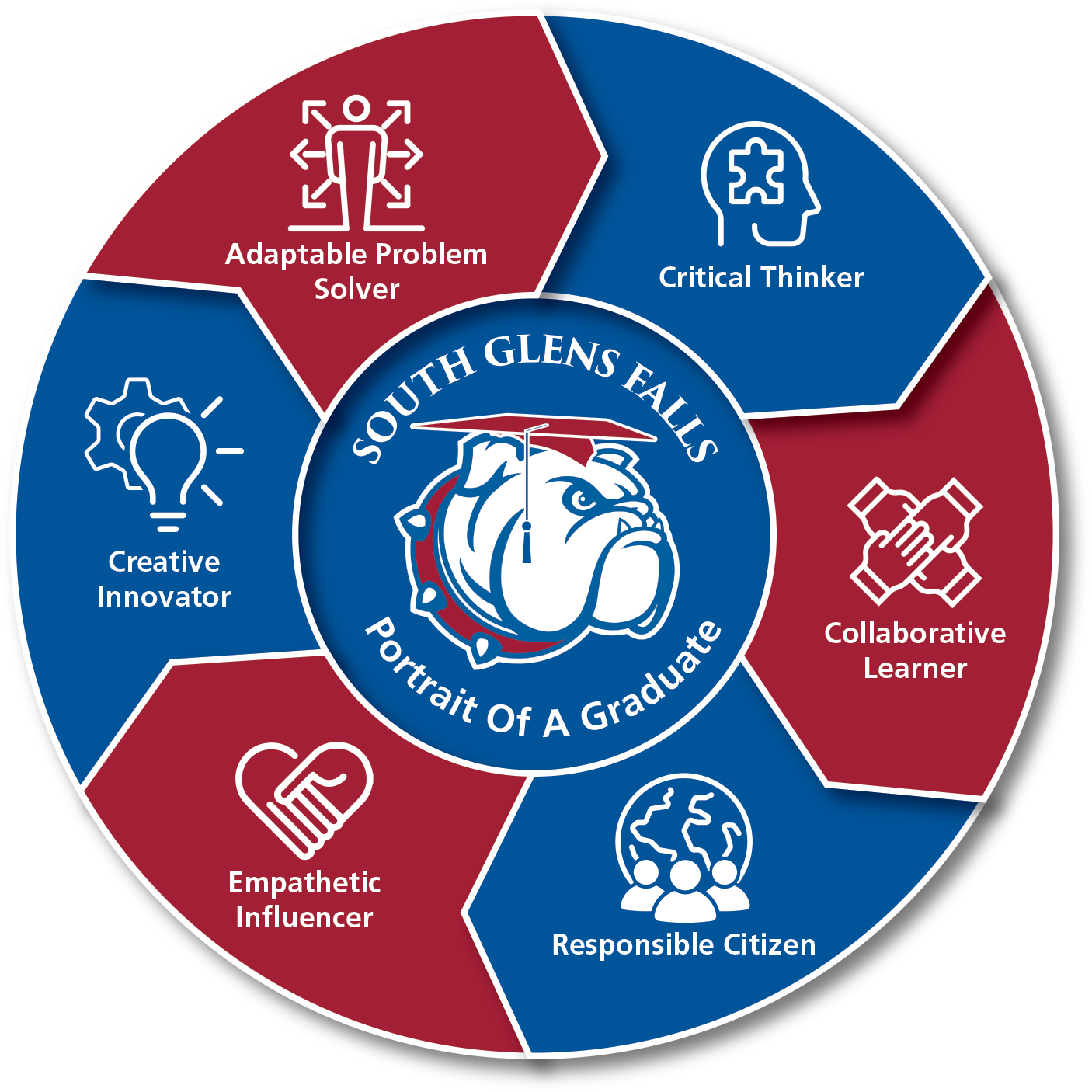
Portrait of a Bulldog Attributes
Our Portrait of a Bulldog articulates six competencies that we believe every student should exhibit as they end their journey with us, and start to forge their own path toward success.
Throughout our course descriptions, you will see icons representing a different attribute. The attributes are listed below.
Adaptable Problem Solver
Adaptable problem solvers consider different points of view and show flexibility and open mindedness when problem solving. Becoming an adaptable problem solver allows students to find solutions in situations that are not anticipated.
Critical Thinker
Critical thinkers understand the ‘bigger picture’ and apply thinking that is clear, rational, open-minded, and informed by evidence. Becoming a critical thinker allows students to successfully engage in the global economy with the ability to analyze information, solve problems and make informed decisions.
Collaborative Learner
Collaborative learners understand and utilize the strengths and skills needed to work productively within a group while honoring diverse perspectives and effectively resolving conflicts. Becoming a collaborative learner allows students to work and communicate with others while understanding, appreciating, and respecting other perspectives and ideas.
Responsible Citizen
Responsible citizens act honestly and demonstrate care for themselves and the local and global communities by conscientiously honoring commitments and owning positive and negative outcomes. Becoming a responsible citizen allows students to understand that their actions will impact their lives and the lives of others.
Empathetic Influencer
Empathetic influencers demonstrate the ability to recognize and share the feelings, emotions, perspectives, and experiences of others in order to respond with compassion and understanding. Becoming an empathetic influencer allows students to recognize, understand, and support the backgrounds and experiences of other people, encouraging students to contribute to their own growth and the growth of their communities.
Creative Innovator
Creative innovators demonstrate originality, imagination, and new ways of thinking beyond traditional ideas, rules, patterns, and relationships. Becoming a creative innovator allows students to live and work with visionary skill sets that are adaptable in an ever-changing world.
Art Department
College credit options
*AP STUDIO ART: DRAWING
POB Attribute: Creative Innovator
1 Unit 1 Year
Students taking the AP course must take the AP examination.
OPEN TO STUDENTS IN GRADES 11-12
Participation in this course is by recommendation from the instructor only. Matriculation into this course requires submission of a portfolio and short essay in order to be considered. Upon successful completion of this course, students may earn college credit for Art Studio. During the year, students will be compiling materials for a portfolio that is the basis of the AP examination. Students should be prepared for a significant amount of after-school and weekend work. There is a non-refundable AP exam fee.
Prerequisite: Completion of Studio in Art and Drawing I
Core Courses
STUDIO IN ART
POB Attribute: Responsible Citizen
1 Unit 1 Year
This is a year-long introductory course into the nature, function and history of the visual arts. Areas of concentration include: observational drawing, design and composition, color and three-dimensional design, as well as inquiry of contemporary and period art movements. Skills will be developed through a variety of media and techniques. At the culmination of this course, students will produce a collection of artwork referred to as a portfolio.
This course meets the state requirements for graduation and is a prerequisite for many other art courses.
Electives
CERAMICS I
POB Attribute: Creative Innovator
.5 Unit 1 Semester
This course can be elected only after successfully completing a full year of Studio in Art. This course is an introduction to the various techniques and skills pertaining to ceramics, including handbuilding, glazing and firing. The instructional modality for this course is based primarily on demonstration and modeling, therefore daily attendance is mandatory. As this is a cooperative studio environment, students are expected to assist with processing clay, creating glazes, loading and unloading kilns and general studio maintenance.
Prerequisite: Completion of Studio in Art
CERAMICS II
POB Attribute: Adaptable Problem Solver
.5 Unit 1 Semester
This course can be chosen after the student has successfully completed a unit of Ceramics I. Students will have the opportunity to further develop their technical and aesthetic applications through a twofold process: 1. Develop an increased awareness of the potential of clay through direct manipulation of materials and forming techniques. 2. "Form Follows Function." Realizing the idea evolves first and dictates the forming techniques, students will employ creative problem solving to arrive at a series of three-dimensional works. Students should be aware that an increased level of work, both quantity and quality, is expected.
Prerequisite: Completion of Ceramics I
DRAWING I
POB Attribute: Critical Thinker
1 Unit 1 Year
This course is for students who desire a more concentrated course in drawing. This course introduces concepts and techniques based on a Western European academic model of drawing instruction developed over the last 500 years. These traditional principles impart a fundamental foundation in realistic and accurate drawing. Students must select this course before Painting I or Drawing II.
Prerequisite: Completion of Studio in Art
**Drawing is the preferred course selection for accelerated eighth-grade Art Studio students entering ninth grade.
DRAWING II
POB Attribute: Adaptable Problem Solver
1 Unit 1 Year
This course is for students who have successfully completed Drawing I with preferably a grade of A or B, and who desire a more in-depth study of drawing. This is an excellent course for art majors putting together a portfolio.
Prerequisite: Completion of Studio in Art and Drawing I
PAINTING
POB Attribute: Adaptable Problem Solver
1 Unit 1 Year
This course is an advanced course for students who have successfully completed Studio in Art and Drawing I. This course is designed to provide students with a solid foundation in painting techniques, principles, and concepts. Students will explore various painting mediums, learn about color theory, develop observational skills, and understand composition.
Prerequisite: Completion of Studio in Art and Drawing
DIGITAL PHOTOGRAPHY
POB Attribute: Critical Thinker
1/2 Unit 1 Semester
Learn the basic concepts of digital photography through hands-on experience with digital software and equipment. The course will address aesthetic principles as they relate to composition, space, exposure, light and color. Students learn how to communicate and analyze images, both as photographers and viewers, and will explore a variety of digital software to retouch, manipulate and create digital images.
Prerequisite: Completion of Studio in Art
DIGITAL DRAWING I and II
POB Attribute: Creative Innovator
1/2 Unit 1 Semester
This course introduces the tools, techniques, and concepts associated with digital drawing. In this half year course, you will learn how to use Chrome Canvas and Autodesk Sketchbook to create drawings. Students conceptualize, design, and produce fantastic and fictional drawings using their imagination.
Prerequisite for digital drawing 2: Completion of Digital Drawing 1
Business Department
College Credit Options
Students can earn up to 12 college credits in the area of business. Students assume the cost of various materials and tuition for SUNY courses. Students must meet SUNY Adirondack’s Early Admission requirements, including an overall GPA of 80 or higher.
PRINCIPLES OF MANAGEMENT
POB Attribute: Critical Thinker
SUNY ADIRONDACK— BUS 102
3 College Credits
1/2 Unit 1 Semester
OPEN TO STUDENTS IN GRADES 11-12
This course will run every other year and will be offered next in 2026-27.
This course develops both the content and process issues of understanding all aspects of management. It defines the functional activities of leadership and teamwork; planning, organizing, staffing, directing and controlling, while stressing the areas of communications; and decision-making, group dynamics, conflict resolution, motivation and individual self-improvement.
PRINCIPLES OF MARKETING
POB Attribute: Critical Thinker
SUNY ADIRONDACK— BUS 103
3 College Credits
1/2 Unit 1 Semester
OPEN TO STUDENTS IN GRADES 11-12
This course will run every other year and WILL be offered in 2026-27.
This course covers the history of marketing and development of current marketing practices. Emphasis is on the marketing concept and the decision-making process. Includes practical applications designed to develop student interest in the field of marketing.
*BUSINESS COMMUNICATION
POB Attribute: Responsible Citizen
SUNY ADIRONDACK—BUS 141
3 College Credits
1/2 Unit 1 Semester
This course will run every other year and WILL be offered in 2027-28.
OPEN TO STUDENTS IN GRADES 11-12
A course in the theory and application of a variety of communication forms used in business. Topics include but are not limited to both written, verbal and technological communication methods. Written methods include letters, memos, reports, resumes and press releases. Verbal methods include professional business presentations and meetings. Students will learn about videoconferencing and podcasting.
*INTRODUCTION TO PERSONAL ECONOMICS
POB Attribute: Critical Thinker
SUNY ADIRONDACK—ECO 101
3 College Credits
1/2 Unit 1 Semester
This course will run every other year and will be offered next in 2027-28.
OPEN TO STUDENTS IN GRADES 11-12
This course introduces students to the subject areas needed to manage their economic future. Students are introduced to the US economic and financial systems, financial planning, banking, consumer credit, retirement planning and investing, health insurance and risk management.
Elective Courses
BUSINESS OWNERSHIP
POB Attribute: Critical Thinker
1/2 Unit 1 Semester
This course will run every other year and will be offered next in 2026-27.
Interested in owning a business? Business Ownership is an introductory course that offers students insight into business creation, planning and operations. Topics of study will include business economics; business start-up and ownership; business operations, financing, marketing and planning; business ethics and social responsibility; and business leadership and technology.
BUSINESS & PERSONAL LAW
POB Attribute: Creative Innovator
1/2 Unit 1 Semester
OPEN TO STUDENTS IN GRADES 10-12
This course introduces students to various areas of the law and enables them to understand the legal rights and responsibilities of individuals, groups and businesses. Topics of study include the United States court system, criminal and civil law, trial procedures, tort law, consumer law and contracts, financial law, family law and cyber law.
SPORTS & ENTERTAINMENT MARKETING
POB Attribute: Creative Innovator
1/2 Unit 1 Semester
This course introduces students to the field of marketing as it relates to the sports and entertainment industries. Students will learn marketing basics, including product development, pricing, product placement and promotion/advertising. In addition, the course will include sports and entertainment media, stadium design and development, developing and marketing a sports team/artist, careers in sports and entertainment marketing and the legal aspects of marketing in the sports and marketing industries.
HOSPITALITY & TOURISM
POB Attribute: Empathetic Influencer
1/2 Unit 1 Semester
This course will run every other year and will be offered next in 2027-28.
The course introduces students to the field of marketing as it relates to the hospitality and tourism industry. Students will learn marketing basics, including product development, pricing, product placement and promotion/advertising. In addition, the course will include restaurant and hotel management, business of travel and tourism, careers in hospitality and tourism, travel, hotel/resort design and development. Students will also learn about the legal aspects of marketing in the hospitality and tourism industry.
PERSONAL FINANCE
POB Attribute: Critical Thinker
1/2 Unit 1 Semester
OPEN TO STUDENTS IN GRADES 10-12
This course is designed to inform students how to manage the basic concepts of their finances. Students will learn: college financing, banking, budgeting, investing and saving, insurance (car, rent/home), rent/mortgages, financial planning to include investing, checking accounts, debt/debt free living, credit, debit/credit cards, and identity theft and how to protect yourself.
English Department
College Credit Options
*AP LANGUAGE & COMPOSITION
POB Attribute: Responsible Citizen
1 Unit 1 Year
OPEN TO STUDENTS IN GRADE 11
AP Language and Composition is an introductory college-level composition. Students cultivate their understanding of writing and rhetorical arguments through reading, analyzing, and writing texts as they explore topics like rhetorical situations, claims and evidence, reasoning and organization, and style. There is a non-refundable AP exam fee.
Students taking the AP course must take the AP examination.
*AP LITERATURE & COMPOSITION
POB Attribute: Critical Thinker
1 Unit 1 Year
Students taking the AP course must take the AP examination.
OPEN TO STUDENTS IN GRADE 12
AP English Literature and Composition is an introductory college-level literary analysis course. Students cultivate their understanding of literature through reading and analyzing texts as they explore concepts like character, setting, structure, perspective, figurative language and literary analysis in the context of literary works. This is a non-refundable AP exam fee.
*INTRODUCTION TO COLLEGE WRITING
POB Attribute: Empathetic Influencer
SUNY ADIRONDACK—ENG 101
3 College Credits
1/2 Unit 1 Semester
OPEN TO STUDENTS IN GRADE 12
This course is a twelfth-grade, semester-length course. It emphasizes instruction and practice in the process of writing, including revision, careful analysis and the sharing of each other’s writing. Assignments include reflection on experience, exposition and interpretation of a text. Information literacy, in the form of research and documentation, will be presented. A grade of C or better is required to enroll in a second writing course (English 102 through English 110). Students assume the cost of various materials and tuition for SUNY courses. Students must meet SUNY Adirondack’s Early Admission requirements, including an overall GPA of 80 or higher.
PREREQUISITE: A minimum score of 85 on the Common Core ELA Regents Examination, final course grade or successful completion of the SUNY Adirondack Accuplacer® Exam
*WRITING IN AND ABOUT LITERATURE
POB Attribute: Critical Thinker
SUNY ADIRONDACK—ENG 108
3 College Credits
1/2 Unit 1 Semester
OPEN TO STUDENTS IN GRADE 12
This course is a writing workshop, in which students read from a diverse selection of short stories, poetry, essays and drama. Writing explores students' responses to critical questions raised by the readings and may include a reference paper examining the life and work of an author. Students assume the cost of various materials and tuition for SUNY courses. Students must meet SUNY Adirondack’s Early Admission requirements.
PREREQUISITE: SUNY Adirondack: Eng 101
Honors Courses
ENGLISH 9 & 10 HONORS
POB Attribute: Critical Thinker
1 Unit 1 Year (Per grade level)
The English Honors Program is designed to challenge the top student in all facets of the communication arts. Along with meeting the English 9 and 10 Regents requirements, each of the literary genres is approached through its historical and philosophical perspective in a humanities setting. Students are required to write in a variety of ways including literary analysis pieces, memoirs, journals, MLA structured pieces, argumentative essays, and creative writing. Reading materials range from complete novels to plays, poetry and short articles.
Core Courses
ENGLISH 9 - CONTEMPORARY LITERATURE
POB Attribute: Critical Thinker
1 Unit 1 Year
Students in this course will analyze a wide range of contemporary literature. Students will be expected to make connections to other texts, world events and themselves through reading, class discussion and writing. Literary terms are reviewed and reinforced, and novels are the basis through which new vocabulary is taught. In addition, each student will be required to complete a research project.
ENGLISH 10 - WORLD LITERATURE
POB Attribute: Critical Thinker
1 Unit 1 Year
World Literature will be a journey across time, genres and themes connected to several different countries. Activities will assess and bolster reading comprehension by examining the literary elements within texts while supporting critical thinking. Course assignments will parallel tasks that will appear on New York State’s Common Core Regents Examination in English and will assess how well the student has learned the skills essential for success on the aforementioned exam. Throughout the year, vocabulary will be studied both in context and through the use of the text. Grammar will also be a focus with integrated assignments to the texts as well as straight written practice. Along with the exploration of world literature, a foundation of current MLA practices will be built throughout the year in the form of mini-research papers, in-text citations, and works cited pages in conjunction with researched written reports.
ENGLISH 11 - AMERICAN LITERATURE
POB Attribute: Critical Thinker
1 Unit 1 Year
American Literature will be a journey through the American experience beginning with early America through to the works of modern America. Students will gain insight into the evolution of America as a nation as they travel across time, genres and themes to uncover what it meant to be part of the American experience. In addition, students will be expected to make connections in literature and other texts with similar events. Throughout the year vocabulary and grammar will also be studied. Research will be embedded in literary units to develop essential skills for locating, incorporating and documenting sources. A research presentation is a required project as a common assessment. All students will take the Common Core ELA Regents Examination.
GRADE 12 - SEMESTER COURSE OPTIONS
Each student will complete two of the following half-year courses. AP Literature and SUNY Adirondack 101/108 will also satisfy the English 12 requirement.
MYTHOLOGY
POB Attribute: Critical Thinker
1/2 Unit 1 Semester
Do you know that the inspiration for many of the details in Harry Potter is Greek mythology? Do you know what aspects of Thor are derived from Norse mythology and what is created by Hollywood? Do you know which words you use everyday that are derived from mythology? World mythology looks at myths from around the world, with a particular emphasis on Greek and Norse myths. Students will learn about the deities (gods and goddesses) for these cultures, as well as read creation stories and heroic myths. We will examine how mythical allusions, archetypes and themes have enriched literature and film, both in the past and today.
HUMAN STRUGGLE AND SOCIAL JUSTICE
POB Attribute: Empathetic Influencer
1/2 Unit 1 Semester
This course is designed to provide understanding of the socially constructed nature of race, class, gender, sexuality, disability and age, and an understanding of how these contribute to discrimination and oppression of historically marginalized members of our population. The course focuses on issues of diversity, oppression and social justice. In addition, students will learn about the influence of dominant culture on these diverse and marginalized groups.
FILM AS LITERATURE
POB Attribute: Critical Thinker
1/2 Unit 1 Semester
Students in the Literature and Film Criticism course will expand their knowledge of literature as text, study the transition of text to film and then analyze the impact on intended audiences. The students will gain a greater appreciation for film, an understanding of how film can impact and has impacted our society and the means to study film just as we study literature. The students will couple analytical reading of texts with active viewing of film and apply their knowledge from past English courses in a new outlet. Students will critically view a wide range of films and compare and contrast films, novels, genres and techniques, in order to analyze the cinematic and theatrical techniques that filmmakers use to translate ideas and texts into film. Writing and speaking skills will be practiced through a wide range of assessments, including analytical writing, presentations, creative pieces, speeches, Socratic discussions, infographics and the creation of both documentary films and movie trailers.
CREATIVE WRITING
POB Attribute: Creative Innovator
1/2 Unit 1 Semester
The Creative Writing course is designed for students who enjoy writing as a form of art and personal expression. In this course, students will explore the elements of a variety of literary genres (short fiction, poetry and drama). Students will have the opportunity to explore several different types of poetry and prose styles, as well as responding to literature, art mediums, quotes and music. Originality and writing that shows thought will be emphasized. To develop these original writing pieces, students will engage in writing workshops, literary element development lessons, writing/author studies, and peer reviews/conferences. To show evidence of writing development throughout the course, students will engage in writing activities that require sharing one's work. Students will be surrounded by like-minded student writers that will help to grow their craft.
POWER OF SPEECH
POB Attribute: Empathetic Influencer
1/2 Unit 1 Semester
Designed for the college- and career-ready student! Build your speaking confidence in a safe space. This course will introduce students to the fundamentals of public speaking. These basics include every step of the process, from researching to outlining and delivering a speech. The course will also focus on the relationship between speaking and listening, gauging an audience and using visual aids as well as modern technology to support and enhance the delivery of the intended message. Students will study speeches and explore audience, purpose and impact of great speeches. In this course, students will write and give an array of speeches demonstrating their capacity to create, deliver and speak with the art of elocution, perform interpretations of literature and present extemporaneous speeches on current events. Through oral assignments and written assignments, students will cultivate strong critical reasoning, as well as analytical and argumentative skills.
SHORT STORIES: I’VE GOT A STORY TO TELL BUT A SHORT TIME TO TELL IT
POB Attribute: Responsible Citizen
1/2 Unit 1 Year
OPEN TO STUDENTS IN GRADE 12
This class is built around the form, function, and enjoyment of the short story. Students will read short stories by genre and theme. Discussions will be varied, from simple element identification to genre analysis. Science fiction, dystopian, historical fiction, fable, frame story, sketch, and vignette will all be covered in this 20-week course. Students will be expected to read and respond, often in writing, about the short work and whether it fits the genre it is listed under. Class discussions will take place weekly. Some examples of the short works covered will be “The Lottery” by Shirley Jackson, “The Funereal” by Kate Wilhelm, and “The Last of the Winnebagos” by Connie Willis. Students will have the opportunity to either create their own short story as a culminating project or choose a short story to apply critical analysis to.
NOTE: This course does not qualify as a NCAA core course, and therefore cannot be used for NCAA initial-eligibility certification.
ENGLISH IN THE REAL WORD
POB Attribute: Critical Thinker
1/2 Unit 1 Semester
Writing plays a crucial role in our daily lives. Almost every situation we encounter demands some form of writing. Despite the widespread availability of computers and technology, there is still paperwork to complete, checklists to compile, and reflections to articulate. Acquiring the necessary writing skills for the diverse formats encountered in the real world is an essential aspect of preparing for life beyond high school. Potential units and assignments include: business and personal letters, emails, blogs & text messages, journals, Invitations, greeting cards and thank you notes, banking forms, classified ads and flyers, lists, job applications, resumes and cover letters, forms and contracts.
NOTE: This course does not qualify as a NCAA core course, and therefore cannot be used for NCAA initial-eligibility certification.
Elective Courses
SPORTS AND SOCIETY
POB Attribute: Responsible Citizen
1 Unit 1 Year
OPEN TO STUDENTS IN GRADES 10-12
This course will study the role of sports around the world and how sports affect today’s society, with particular attention on how sports are organized, played, experienced, observed, perceived and critiqued. Specific topics include youth sports, media, current trends, money, politics, race, gender, culture, commercialization, violence, education and college sports. Sports will also be studied as a microcosm of society, in that while studying issues in sports, we will also be able to learn about society. This course is discussion and project based. In addition, the students in this course maintain "South High Sports" social media and class time each week is set aside to work on choice projects to promote South High Sports.
Health & Physical Education Departments
HEALTH
POB Attribute: Collaborative Learner
1/2 Unit 1 Year
Health education is an interdisciplinary course about the sociological, psychological and physiological effects on one’s status as a human being. The objective of this required half-year course is to make the students aware of the benefits derived from establishing positive health behaviors. Subject areas investigated during the course are first aid, disease and disease prevention, mental health, drug education, nutrition and family life education. A variety of approaches are used, such as videotapes, articles, films and guest lectures to provoke thought and stimulate change. This course is required for graduation.
PHYSICAL EDUCATION
POB Attribute: Collaborative Learner
1/2 Unit 1 Year
Physical Education prepares students with the knowledge and skills to lead healthy lives. The physical education classes are designed using a choice model. Students may choose between 3 different options, which they will participate in for the year. Listed below are some examples of the activities covered in each choice.
Team Sports ( ex: flag football, soccer, basketball, badminton, volleyball)
Lifetime activities (ex: pickleball, badminton, archery, frisbee golf, volleyball)
Leisure (ex: walking, personal fitness)
PEAK PERFORMANCE
POB Attribute: Collaborative Learner
1/2 Unit 1 Year
OPEN TO STUDENTS IN GRADES 10-12
This course is a focused and one-of-a-kind physical education opportunity. It is an experience designed to create a physical change in participants throughout multiple fitness areas. Participants who take this course will learn a variety of fitness concepts, and capture the working intensity that creates a physiological change. Responses from training will include:
Strength increase in multiple planes of movement (i.e. horizontal, vertical and diagonal)
An increase in explosive power
The ability to accelerate and decelerate properly
Anaerobic conditioning and flexibility
Along with these physical and performance-based improvements, students will hone their mental toughness, persistence, composure and self-discipline. Participants will develop a greater understanding of the importance of both physical and mental peak performances for any endeavor.
INTRODUCTION TO WEIGHT TRAINING
POB Attribute: Collaborative Learner
1/2 Unit 1 Year
This class offers a weight room experience for students interested in gaining knowledge in how to effectively utilize the weight room for improving personal strength and fitness. This class will offer a continued weight room experience throughout the school year for students to progress and develop competency and proficiency in several weight room related skills. This class is ideal for 9th grade students or 10th,11th and 12th grade students who have not yet taken Peak Performance.
Mathematics Department
Course placement is determined by student academic performance and teacher recommendation.
College Credit Options
*CALCULUS I (Fall) 1/2 Unit 1 Semester
SUNY ADIRONDACK— MAT 131
*CALCULUS II (Spring) 1/2 Unit 1 Semester
POB Attribute: Critical Thinker
SUNY ADIRONDACK— MAT 132
4 College Credits (for each course)
These courses are SUNY Adirondack courses taught at South Glens Falls High School. These are differential calculus courses taught from a numeric, graphic and algebraic perspective. Topics include but are not limited to: functions, graphing, average/instantaneous rates of change, limits, derivatives, anti-derivatives, optimization, analytic geometry and the definite integral. Students assume the cost of various materials and the tuition. A graphing calculator is required. Students must meet SUNY Adirondack’s Early Admission requirements, which may include meeting a required score on the Accuplacer® exam.
PREREQUISITES: Students need at least a 75% on the Algebra 2 Regents exam and at least a 75% overall course average in pre-calculus to be eligible for MAT 131 for collegiate credit.
*AP COMPUTER SCIENCE PRINCIPLES
POB Attribute: Creative Innovator
1 Unit 1 Year
Students taking the AP course must take the AP examination.
OPEN TO STUDENTS IN GRADES 10, 11, 12
AP Computer Science Principles is an introductory college-level computing course that introduces students to the breadth of the field of computer science. Students learn to design and evaluate solutions and to apply computer science to solve problems through the development of algorithms and programs. They incorporate abstraction into programs and use data to discover new knowledge. Students also explain how computing innovations and computing systems—including the internet—work, explore their potential impacts, and contribute to a computing culture that is collaborative and ethical. There is a non-refundable AP exam fee.
PREREQUISITES: Successful completion of Regents Algebra or higher, or successful completion of Computer Science I & II
*INDEPENDENT STUDY IN COMPUTER SCIENCE
POB Attribute: Critical Thinker
1/2 Unit 1/2 Year
Students taking the AP course must take the AP examination.
OPEN TO STUDENTS IN GRADE 12
This Independent Study in Computer Science course offers students the opportunity to explore a specialized area of interest within the field of computer science through self-directed learning. Students will design and implement a personalized project, guided by a faculty advisor, in a topic of their choosing—ranging from algorithms, artificial intelligence, machine learning, software engineering, cybersecurity, data science, computer graphics, and beyond. This course is ideal for students with a strong foundation in computer science who seek to deepen their knowledge in a specific area of computer science.
Prerequisites: Students must have successfully completed all AP Computer Science courses offered, and must receive approval from their computer science teacher.
*AP COMPUTER SCIENCE A
POB Attribute: Critical Thinker
1 Unit 1 Year
Students taking the AP course must take the AP examination.
OPEN TO STUDENTS IN GRADES 11 and 12
AP Computer Science A is a course that uses object-oriented programming to introduce fundamental topics that include problem solving, design strategies and methodologies, organization of data (data structures), approaches to processing data (algorithms), analysis of potential solutions and the ethical and social implications of computers. The language used in this course is Java as this is the language tested on the AP exam. AP guidelines provide a framework for the course and require rigor at a college level. Students should be willing to accept the challenge of the coursework because they will have a significant amount of work outside of class time. There is a non-refundable AP exam fee.
Prerequisites: Successful completion of Geometry (Regents) or higher, or successful completion of Computer Science 1 & 2.
Core Courses
ALGEBRA
POB Attribute: Critical Thinker
1 Unit 1 Year
This one-year course is aligned with the Next Generation Learning Standards and prepares students for the Next Gen Algebra Regents Examination. Topics include solving linear equations and inequalities, systems of linear equations/inequalities, absolute value functions, quadratic functions, exponential functions, piecewise functions, radical expressions and functions, transformations of functions, polynomials, statistics, data analysis and arithmetic sequences. Students will take the Next Gen Algebra Regents Examination in June, which may count as one-fifth of the student's overall average.
ALGEBRA with LAB
POB Attribute: Critical Thinker
1 Unit 1 Year
This class will have additional time built into the schedule to help students meet the challenges of this Regent’s level math class. The purpose of this course is to cover the Algebra curriculum in one year and allow for additional time for practice and activities to help strengthen math skills. This course is aligned with the Next Generation Learning Standards and prepares students for the Next Gen Algebra Regents Examination. Topics include solving linear equations and inequalities, systems of linear equations/inequalities, absolute value functions, quadratic functions, exponential functions, piecewise functions, radical expressions and functions, transformations of functions, polynomials, statistics, data analysis and sequences. Students will take the Next Gen Algebra Regents Examination in June, which may count as one-fifth of the student's overall average.
ALGEBRA - PART I
POB Attribute: Collaborative Learner
1 Unit 1 Year
This is the first year of a two-year sequence that prepares students for the Next Gen Algebra Regents Examination that will be taken in June of the second year (during the Algebra Part II course). This course is aligned with the Next Generation Learning Standards. Topics include functional notation, rational numbers, linear equations and proportional reasoning, linear functions and operations of polynomials. A local final exam may be given in June.
ALGEBRA - PART II
POB Attribute: Collaborative Learner
1 Unit 1 Year
This is the second year of a two-year sequence that prepares students for the Next Gen Algebra Regents Examination that will be taken in June. This course is aligned with the Next Generation Learning Standards. Topics include factoring, quadratic functions, exponential functions, statistics, data analysis and a review of functions. Students will take the Next Generation Algebra Regents Examination in June.
GEOMETRY
POB Attribute: Adaptable Problem Solver
1 Unit 1 Year
This course is aligned with the Next Generation Learnings Standards and prepares students for the Next Gen Geometry Regents Examination. Students will learn how to use more precise definitions to establish the validity of geometric conjectures through deduction, proof or mathematical arguments. Topics include congruence, proofs, constructions, similarity and right triangles, measurement and volume, transformational geometry, coordinate geometry and circle geometry. Students will take the Next Gen Geometry Regents Examination in June, which may count for one-fifth of the student's overall average. Students must pass the Algebra regents exam with a 65% to enroll. Students must pass the Algebra regents exam with a 65% to enroll.
GEOMETRY WITH LAB
POB Attribute: Adaptable Problem Solver
1 Unit 1 Year
This class will have additional time built into the schedule to help students meet the challenges of this Regent’s level math class. The purpose of this course is to cover the geometry curriculum in one year and allow for additional time for practice and activities to help strengthen math skills. This course is aligned with the Next Generation Learning Standards and prepares students for the Next Gen Geometry Regents Examination . Students will learn how to use more precise definitions to establish the validity of geometric conjectures through deduction, proof or mathematical arguments. Topics include congruence, proofs, constructions, similarity and right triangles, measurement and volume, transformational geometry, coordinate geometry and circle geometry. Students will take the Next Gen Geometry Regents Examination in June, which may count as one-fifth of the student’s overall average.
FOUNDATIONS IN GEOMETRY
POB Attribute: Adaptable Problem Solver
1 Unit 1 Year
This course introduces students to the basic concepts in geometry. Topics may include transformations, triangle relationships, measuring in the plane and space, reasoning and parallel lines, quadrilaterals and similarity.
NOTE: This course does not qualify as a NCAA core course, and therefore cannot be used for NCAA initial-eligibility certification.
ALGEBRA 2
POB Attribute: Critical Thinker
1 Unit 1 Year
This course is aligned with the Common Core Learning Standards and prepares students for the Algebra 2 Common Core Regents Examination. Topics include linear functions, quadratic functions, polynomials, radical functions, exponentials, logarithmic functions, rational functions, sequences, series, trigonometry, probability and statistics. Students will take the Next Gen Algebra 2 Common Core Regents Examination in June, which may count as one-fifth of the student’s overall average. Students must pass the Geometry regents exam with a 65% to enroll. Students must pass the Geometry regents exam with a 65% to enroll.
ALGEBRA 2 WITH LAB
POB Attribute: Critical Thinker
1 Unit 1 Year
This class will have additional time built into the schedule to help students meet the challenges of this Regent’s level math class. The purpose of this course is to cover the Algebra 2 curriculum in one year and allow for additional time for practice and activities to help strengthen algebra skills. This course is aligned with the Common Core Learning Standards and prepares students for the Algebra 2 Common Core Regents Exam. Topics include linear functions, quadratic functions, polynomials, radical functions, exponentials, logarithmic functions, rational functions, sequences, series, trigonometry, probability and statistics. Students will sit for the Next Gen Algebra 2 Common Core Regents exam in June which may count as one-fifth of the student’s overall average.
FOUNDATIONS IN ALGEBRA 2
POB Attribute: Collaborative Learner
1 Unit 1 Year
This course introduces students to advanced topics in Algebra 2. This course is not designed to cover all the concepts required for the Algebra 2 Next Gen Regents Examination. Topics may include linear functions, quadratic functions, exponential and logarithmic functions, rational functions, trigonometry, sequences, series, probability and statistics.
NOTE: This course does not qualify as a NCAA core course, and therefore cannot be used for NCAA initial-eligibility certification.
TOPICS IN MATHEMATICS
POB Attribute: Adaptable Problem Solver
1 Unit 1 Year
This course provides students with the opportunity to earn a third unit of credit in mathematics. The intent is to show students how and where mathematics can be found in the world around us. Topics may include exponential functions, quadratic equations, number systems, graph theory, financial math, logic, probability and statistics.
NOTE: This course does not qualify as a NCAA core course, and therefore cannot be used for NCAA initial-eligibility certification.
FINANCIAL ALGEBRA
POB Attribute: Responsible Citizen
1 Unit 1 Year
This course is designed as a senior-level math course that will use mathematics to give students the tools to become financially responsible young adults. The course employs algebra, precalculus, probability and statistics, and geometry to solve financial problems that occur in everyday life. Real-world problems in credit, banking, auto insurance, mortgages, employment, income taxes and budgeting are solved by applying the relevant mathematics. Projects, computer spreadsheets and graphing calculators are key components of this course.
NOTE: This course does not qualify as a NCAA core course, and therefore cannot be used for NCAA initial-eligibility certification.
PRECALCULUS
POB Attribute: Critical Thinker
1 Unit 1 Year
This course is designed as a preparatory course for Calculus. The main focus of the course is the study of functions. Other topics of study include sequences, series, advanced work in algebra, parametric equations, limits and continuity of functions. A local final exam will be given in June which will count as one-fifth of the student's overall average.
Students need at least a 75% overall course average in precalculus and a minimum grade of a 75 on the Algebra 2 Regents exam to be eligible for MAT 131 (Calculus 1) for collegiate credit.
FOUNDATIONS IN PRECALCULUS
POB Attribute: Critical Thinker
1 Unit 1 Year
This is an upper-level course that uses an applied approach to teach advanced math topics using technology. Topics may include functions, sequences, advanced work in algebra, sequences, matrices and some discrete math topics.
STATISTICS AND PROBABILITY I (Fall) 1/2 Unit Semester 1
STATISTICS AND PROBABILITY II (Spring) 1/2 Unit Semester 2
POB Attribute: Critical Thinker
Statistics and Probability Part I and Part II is a college-preparatory course that will introduce students to the major concepts and skills used in statistics and probability. The students will be introduced to the tools for collecting, analyzing and drawing conclusions from data. Students are exposed to broad conceptual themes that will include:
Exploring data: describing patterns and departures from patterns
Sampling and experimentation: planning and conducting a study
Anticipating patterns: exploring random phenomena using probability and simulation
Statistical inference: estimating population parameters and testing hypotheses
Note: Students may opt to only take Statistics and Probability I for semester 1 only. Students who wish to take a full year of Statistics and Probability must take Statistics and Probability I and then continue on to Statistics and Probability II for the second semester.
PREREQUISITES: Students must have successfully completed Algebra 2 or Algebra 2 with Lab to take Statistics and Probability I and Statistics and Probability II.
DISCOVERING COMPUTER SCIENCE
POB Attribute: Creative Innovator
1 Unit 1 Year
OPEN TO STUDENTS IN GRADES 9, 10, 11
This is an introductory course for students with minimal prior experience in computer science. The course presents an overview of the principles and applications of computer science, as well as an introduction to programming. Students will start by programming in Netsblox, a friendly graphical language that will allow students to create interactive games, animations, and stories, while learning the fundamentals of computer programming. Students will continue to develop their programming and problem solving skills using the text based language Python. Finally, students will learn how to design their own website using HTML, CSS and JavaScript.
NOTE: This course does not qualify as a NCAA core course, and therefore cannot be used for NCAA initial-eligibility certification.
COMPUTER SCIENCE 1 (Fall) 1/2 Unit 1 Semester
COMPUTER SCIENCE 2 (Spring) 1/2 Unit 1 Semester
POB Attribute: Adaptable Problem Solver
OPEN TO STUDENTS IN GRADES 10-12 AND 9TH GRADERS WITH TEACHER APPROVAL
These half-year courses introduce students to computer science with fundamental programming topics that include programming, computer commands, variables and formulas, loops and arrays functions. Students will be introduced to the Python programming language and use this platform to explore programming techniques.
NOTE: This course does not qualify as a NCAA core course, and therefore cannot be used for NCAA initial-eligibility certification.
MATH SAT PREP
POB Attribute: Adaptable Problem Solver
No Credit
OPEN TO STUDENTS IN GRADES 11 AND 12
Math SAT Prep is designed to help prepare students for the SAT test. In addition to reviewing the mathematical skills assessed on the SAT test, students learn test-taking strategies specific to the exam. There will be an emphasis placed on reading and understanding questions to identify key facts needed for problem solving. Students will also be engaged in online learning sessions. Material includes samples with explanations, practice tests and study resources. Independent practice is followed by guided collaborative review. Upon successful completion, students will possess the tools necessary to complete the SAT to the best of their ability.
Music Department
MUSICAL ENSEMBLES
Students who enroll in ensembles find musical performance a satisfying experience. As students mature and further develop their musical skills, they also develop leadership qualities. These students serve as positive role models for less-experienced performers. Once enrolled in performing ensembles, it is anticipated that students will continue to enroll for the duration of their high school careers.
The groups study technical and interpretive principles pertaining to their instruments or voices and engage in rehearsals for specific performances.
Attendance at lessons and all performances is required for all band, orchestra and choir students. In addition, groups may participate at school or community events and attend professional concerts. Expectations for credit include two music concerts per year, small sectional meetings and other events.
CONCERT BAND
POB Attribute: Responsible Citizen
1/2 Unit 1 Year
Band is open to musicians seeking the highest musical standards who are eager to work hard, perform at a high level and enjoy music. Members are required to perform at the Holiday Parade, Memorial Day Parade, Flag Day Parade and concerts throughout the school year. Attendance at all functions is required. Students must have the proper qualifications and have continuous prior membership in band. Participation is under the discretion of the conductor.
JAZZ BAND
POB Attribute: Responsible Citizen
1/2 Unit 1 Year
Students must pass an audition or be recommended by the band instructor in order to participate in this course. Jazz Band, which consists of alto and tenor Saxophones, baritone saxophone, trumpets, trombones and a rhythm section, meets on alternate days and has performances in November, March/April, and in June. All jazz band members must be part of another musical ensemble.
CHORALIERS
POB Attribute: Responsible Citizen
1/2 Unit 1 Year
Choraliers is an auditioned choral group designed to challenge advanced vocalists. Students must pass an audition or be recommended by the choir instructor in order to participate in this course.
VOCAL POINT
POB Attribute: Responsible Citizen
1 Unit 1 Year
Students must audition and be selected in order to participate in this course. The focus will be on independent part singing and contemporary a cappella music. Vocal Point will meet on alternate days and members must be concurrently enrolled in another choral ensemble.
ORCHESTRA
POB Attribute: Responsible Citizen
1/2 Unit 1 Year
Orchestra is open to students with the proper technical preparation, continuous prior membership in orchestra, the desire to develop musically and the recommendation of the director.
CHAMBER ORCHESTRA
POB Attribute: Responsible Citizen
1/2 Unit 1 Year
The Chamber Orchestra is an auditioned string ensemble that is designed to challenge the most-skilled string students. Chamber Orchestra will explore a wide range of classic concert string literature. It meets every other day and performs for evening concerts.
INTRODUCTION TO THEATRE ARTS (offered 2026-2027 academic year)
POB Attribute: Creative Innovator
1 Unit 1 Year
This course will include the study of Greek theatre origins and acting methods, such as Alexander Technique, Linklater Voice, Meisner, etc. Students will also learn theatre etiquette, scene study/character development and improvisation, historical text analysis, production design, playwriting, performance applications, elevated text analysis, stage combat, choreography, make-up design and historical context application.
MUSICAL THEATRE I (next offered in the 2027-2028 academic year)
POB Attribute: Creative Innovator
1 Unit 1 Year
Musical Theatre I is a history and performing based course open to students in grades 9-12. The course is designed to examine the emergence and significance of America’s most unique contribution to the literary and performing arts, the Broadway musical, while also building a performing skillset in acting, singing, and dancing. Through readings, audio and video recordings, and live performance, this course will examine the Broadway musical from its 19th-century beginnings through the current season.
MUSIC THEORY
POB Attribute: Adaptable Problem Solver
1 Unit 1 Year
Music Theory is open to students who hold a basic comprehension of music notation; proficiency on an instrument or voice is recommended. The course covers all aspects of music, including ear training, notations, keys, scales, chords, composition and analysis. Emphasis is on a theoretical understanding through aural comprehension. Theory is recommended to any student considering entering the field of music or desiring a deeper understanding of musical concepts.
MUSIC IN OUR LIVES
POB Attribute: Collaborative Learner
1 Unit 1 Year
This course is a culmination of the general music program of studies grades K-8. Students will be listening, performing, composing, and using basic music skills to permit musical involvement. Students will also play a variety of musical instruments in class. This course will fulfill the requirements for the Fine Arts credit in High School.
Science Department
College Credit Options
*FORENSIC CHEMISTRY - SUPA
POB Attribute: Collaborative Learner
(Syracuse University Project Advance)
4 College Credits
1 Unit 1 Year
OPEN TO STUDENTS IN GRADES 11-12
Forensic Science is based upon the application of scientific methods and techniques to crime and law. Recent advances in scientific methods and principles have had an enormous impact upon law enforcement and the entire criminal justice system. In this course, scientific methods specifically relevant to crime detection and analysis will be presented. Topics included are blood analysis, organic and inorganic evidence analysis, microscopic investigations, hair analysis, DNA, drug chemistry and toxicology, fiber comparisons, paints, glass compositions and fragmentation, fingerprints, soil comparisons and arson investigations, among others. Laboratory exercises will include techniques commonly employed in forensic investigations. There is a non-refundable tuition fee to Syracuse University.
Prerequisite: Completion of Regents Chemistry
*AP BIOLOGY
POB Attribute: Adaptable Problem Solver
1 Unit 1 Year
Students taking the AP course must take the AP examination.
This course offers students the opportunity to take a college-level biology course. It prepares students to take the AP examination in Biology. Many colleges award credit and/or advanced standing to students who have earned a satisfactory grade on the AP exam. Students should check with the colleges and universities to which they apply for their policies on giving incoming freshmen credit for Advanced Placement coursework. There are three major areas of study: molecules and cells, genetics and evolution and organisms and populations. Laboratory work is heavily emphasized in this course. There is a non-refundable AP exam fee.
PREREQUISITES: Completion of Living Environment Regents and Chemistry Regents
* AP CHEMISTRY
POB Attribute: Adaptable Problem Solver
1 Unit 1 Year
Students taking the AP course must take the AP examination.
This course offers students the opportunity to take a college-level chemistry course. It prepares students to take the AP examination in Chemistry. Many colleges award credit and/or advanced standing to students who have earned a satisfactory grade on the AP exam. Students should check with the colleges and universities to which they apply for their policies on giving incoming freshmen credit for Advanced Placement coursework. Students will explore chemistry through inquiry-based lab investigations as they explore the four big Ideas: scale, proportion, and quantity; structure and properties of substances; transformations; and energy. Laboratory work is heavily emphasized in this course. There is a non-refundable AP exam fee.
PREREQUISITE: Completion of Chemistry Regents
Honors
HONORS EARTH AND SPACE SCIENCE REGENTS
POB Attribute: Critical Thinker
1 Unit 1 Year
This honors-level course is designed to challenge the top students in the New York State P-12 Science Learning Standards Curriculum: Space Systems, History of the Earth, Earth’s Systems, Weather and Climate, and Human Sustainability Curriculum. Students considering Honors Earth Science should be ready for a fast paced course which will allow for deeper exploration and a contemporary interdisciplinary approach to the study of the earth and its environment. Topics including geology, meteorology, astronomy, oceanography and climatology are incorporated in both text and laboratory investigations. The New York State Earth and Space Science Regents Examination concludes this course.
HONORS CHEMISTRY REGENTS
POB Attribute: Critical Thinker
1 Unit 1 Year
A challenging recitation and laboratory course with a modern view of chemistry. Topics include: energy and matter, atomic and molecular structure, bonding, periodic table, mathematics of chemistry, kinetics and equilibrium, redox and electro-chemistry, organic chemistry and principles of reactions. This course will be taught at a faster pace than Regents Chemistry and will include advanced material in each of the topics. The Chemistry Regents Examination concludes this course.
CO-REQUISITE: Students must also be enrolled in Regents Algebra 2.
Core Courses
Students are required to successfully complete three units of science for graduation. Of the three units, one must be from the Living Environment curriculum and one from the Physical Setting.
REGENTS COURSE LABORATORY REQUIREMENT
As a prerequisite for admission to any Regents Examination in science, students MUST have successfully completed 1,200 minutes, including New York State Science investigations with satisfactory written reports for each laboratory investigation.
BIOLOGY REGENTS
POB Attribute: Critical Thinker
1 Unit 1 Year
This course follows the New York State P-12 Science Learning Standards Curriculum: Structure and Function, Matter and Energy in Organisms and Ecosystems, Interdependent Relationships in Ecosystems, Inheritance and Variation of Traits, Natural Selection and Evolution Curriculum. This course may consist of a mixture of long- and short-term projects, textbook readings, lecture-discussions and laboratory work. The New York State Biology Regents Examination concludes this course.
EARTH AND SPACE SCIENCE REGENTS
POB Attribute: Critical Thinker
1 Unit 1 Year
Regents Earth Science follows the New York State P-12 Science Learning Standards Curriculum: Space Systems, History of the Earth, Earth’s Systems, Weather and Climate, and Human Sustainability Curriculum. This is a contemporary, interdisciplinary approach to the study of the earth and its environment. Topics from geology, meteorology, astronomy, oceanography and climatology are incorporated in both text and laboratory investigations. The course is developed around the conceptual themes of science as inquiry, comprehension of scale, prediction, uniformity of process, universality of change, flow of energy in the universe, conservation of mass and energy, the earth-moon system and historical development. The New York State Earth and Space Science Regents Examination concludes this course.
CHEMISTRY REGENTS
POB Attribute: Critical Thinker
1 Unit 1 Year
Regents Chemistry follows the New York State Core Chemistry Curriculum. This is a recitation and laboratory course with a modern view of chemistry. Topics include: energy and matter, atomic and molecular structure, bonding, periodic table, mathematics of chemistry, kinetics and equilibrium, redox and electro-chemistry, organic chemistry and principles of reactions. The Chemistry Regents Examination concludes this course.
INTRODUCTION TO CHEMISTRY
POB Attribute: Critical Thinker
1 Unit 1 Year
Designed for juniors and seniors who need a college preparatory physical science credit, but not necessarily a Regents Examination credit for their science sequence, this survey course is designed to explore, develop and apply the basic fundamental concepts of chemistry as they relate to everyday life. Students will take a locally-developed final exam in June.
NOTE: This course does not qualify as a NCAA core course, and therefore cannot be used for NCAA initial-eligibility certification.
PREREQUISITE: Completion of two science courses and at least one Regents Examination
PHYSICS REGENTS
POB Attribute: Adaptable Problem Solver
1 Unit 1 Year
Regents Physics follows the New York State Core Physics Curriculum. A recitation and lab course which includes the mathematical treatment of topics such as force and motion, energy transfers, wave phenomena, electricity, quantum mechanics. Normally taken in grades 11 and 12. A Regents exam concludes this course.
Prerequisite: Completion of Chemistry Regents
PRACTICAL FORENSICS
POB Attribute: Collaborative Learner
1 Unit 1 Year
A full-year course that covers a variety of topics of forensics including: fingerprinting, facial reconstruction, blood spatter, anthropology, entomology, crime scene processing, various laboratory techniques, and legal aspects of forensics, current events and careers in forensics. The focus of this course is “hands-on” learning. Students should be able to solve mathematical formulas as well as apply mathematical concepts to a variety of situations.
PREREQUISITE: Completion of two science courses and at least one Regents Examination
ENVIRONMENTAL SCIENCE
POB Attribute: Responsible Citizen
1 Unit 1 Year
Discover how the natural world works and how human actions shape our planet. In Environmental Science, students explore key topics such as ecosystems, biodiversity, energy use, climate change, and sustainable resource management. Through hands-on labs, activities, and data analysis, students learn to think critically about environmental challenges and develop science-based solutions. This course is ideal for students interested in biology, earth science, or environmental policy.
PREREQUISITE: Completion of two science courses and at least one Regents Examination
NOTE: This course does not qualify as a NCAA core course, and therefore cannot be used for NCAA initial-eligibility certification.
ANATOMY AND PHYSIOLOGY
POB Attribute: Collaborative Learner
1 Unit 1 Year
OPEN TO STUDENTS IN GRADES 11-12
The Anatomy and Physiology course will teach students about the relationships between the structures and functions of the human body. Students will also learn the mechanisms for maintaining homeostasis within the human body, explore the causes of diseases and develop an understanding of how the human body works. This course will involve laboratory activities and projects, including dissections.
PREREQUISITE: Completion of two science courses and at least one Regents Examination
SOCIAL STUDIES DEPARTMENT
The New York State Education Department’s Seal of Civic Readiness (as per NYSED handbook)
“The Seal of Civic Readiness is a formal recognition that a student has attained a high level of proficiency in terms of civic knowledge, civic skills, civic mindset, and civic experiences. The Seal of Civic Readiness distinction on a high school transcript or diploma:
Shows the student’s understanding of a commitment to participatory government; civic responsibility and civic values;
Demonstrates to universities, colleges, and future employers that the student has engaged in meaningful civic experiential learning; and
Recognizes the value of civic engagement and scholarship”
Students can earn credit toward the Seal through a combination of approved high school coursework, volunteer activities, clubs, select outside employment, etc. Students can begin earning credit in 9th grade. The Seal of Civic Readiness also serves as an approved NYS pathway to graduation.
AMERICAN CITIZENSHIP - NYSED Seal of Civic Readiness Course
POB Attribute: Responsible Citizen
1/2 Unit 1 Semester
OPEN TO STUDENTS IN GRADES 9-12
This course is dedicated to developing the social and political responsibilities associated with participation in a democratic society. Identifying, describing and contrasting the roles of the individual in opportunities for social and political participation while demonstrating respect for the rights of others in discussions and classroom debates and growing the ability to respectfully disagree with other viewpoints and provide evidence for a counter argument will be central to the course. Students will participate in activities that focus on local community, state and national issues. Students will be asked to demonstrate a sense of self as an active participant in society, willing to contribute to solving local and or national issues while committing to balancing the common good with individual liberties. Likewise, students will be learning to respect fundamental democratic principles such as freedom of speech, freedom of press and the rule of law while valuing equity, inclusivity, diversity and fairness. Growing one's ability to respect, and demonstrate empathy for the views of people with other opinions and life perspectives will also be emphasized.
GLOBAL CITIZENSHIP - NYSED Seal of Civic Readiness Course
POB Attribute: Empathetic Influencer
1/2 Unit 1 Semester
OPEN TO STUDENTS IN GRADES 9-12
This course will fulfill social and political responsibilities associated with living in an interdependent global community by developing awareness of and / or engaging in global issues as a citizen. The world is becoming a smaller, increasingly interconnected place. This course will explore human rights and violations of human rights in the past and present through individual and collective experiences. Students will compare and contrast authoritarian societies with democratic ones. Through course study, students will discover the wider world we live in and the importance of being a Global Citizen on various issues. Students will analyze and evaluate news (new literacy) media, social media and other sources of information for accuracy, bias, reliability, and credibility. Students will engage in activities that work toward the public good in a global community while learning about the social and political responsibilities associated with participation as a global citizen.
CIVIC READINESS CAPSTONE PROJECT COURSE - NYSED seal of civic readiness course
POB Attribute: Responsible Citizen
1 Unit 1 Year
OPEN TO STUDENTS IN GRADE 12
The Civic Readiness Capstone Project course is dedicated to providing students with an authentic, hands-on, immersive civics experience. Students will apply Civic Knowledge, Civic Skills and Actions, and use a Civic Mindset to identify an issue of their choosing, conduct research with regard to the issue, evaluate possible solutions, and design/execute an action plan to address the issue. Students will have the opportunity to talk with issue experts in the field, meet with issue stakeholders (elected officials, industry leaders, citizens, etc.), develop strategies and compare with current research, and be part of a solution to a problem they feel needs addressing locally, statewide, or nationally. The course will culminate in a project presentation to the School Civic Readiness Committee and a student reflection. Throughout the course students will have assistance in the research and development process and be given feedback at each stage. If you are a student who likes a hands-on learning experience. If you like finding solutions to problems. If you like digging into an issue and learning all about it. This class is for you.
College Credit Options And Honors Courses
GRADE 9
GLOBAL HISTORY AND GEOGRAPHY HONORS
POB Attribute: Critical Thinker
1 Unit 1 Year
This course is designed to prepare students for higher-level social studies courses. The curriculum is the same as the Grade 9 Global History and Geography course, with emphasis placed on critical thinking and writing skills.
GRADE 10
*AP WORLD HISTORY
POB Attribute: Critical Thinker
1 Unit 1 Year
Students taking the AP course must take the AP examination.
AP World History investigates 1,200 BCE to the present using a student-centered approach to learning. Students develop and use the same skills, practices and methods employed by historians. AP World History requires students to grapple with others’ ideas as they formulate their own perspectives on history. Students looking to enroll in AP World are expected to complete readings and view lectures outside of class in preparation for classroom discussions, collaborative learning activities, as well as project-based learning.
Successful completion of this college-level course will prepare students to take the AP World History Exam and possibly earn 6 college credits. There is a non-refundable AP exam fee.
GRADE 11
*AP U.S. HISTORY
POB Attribute: Critical Thinker
1 Unit 1 Year
Students taking the AP course must take the AP examination.
This course is offered to juniors and seniors who are serious about American history. Upon successful completion of this course, students may earn college credit for U.S. History and will also fulfill the New York State U.S. History and Government requirement. This course is taught at the college level and students will need to take both the AP U.S. History exam and the New York state U.S. History and Government Regents Examination. There is a non-refundable AP exam fee.
GRADE 12
*AP GOVERNMENT & POLITICS
POB Attribute: Critical Thinker
1 Unit 1 Year
Students taking the AP course must take the AP examination.
This course is for students who desire the most rigorous challenge. This course concentrates on national government. It deals with the structure and functioning of each branch of the federal government, constitutional and political theory, political behavior including individuals, interest groups and political parties and the federal bureaucracy. Additionally, this course will cover the mandated economics standards required for graduation. Topics will include supply and demand, market structures, government oversight of the economy, as well as topics related to entrepreneurship and consumer economics. Since students will be receiving an honors designation for the economics portion of this course, they will be expected to read extensively, do more individual study and examine topics at a greater depth. Strong independent reading and writing skills are expected. There is a non-refundable AP exam fee.
*AP PSYCHOLOGY
POB Attribute: Critical Thinker
1 Unit 1 Year
OPEN TO STUDENTS IN GRADES 11-12
Students taking the AP course must take the AP examination.
The AP Psychology course introduces students to the systematic and scientific study of human behavior and mental processes. While considering the psychologists and studies that have shaped the field, students explore and apply psychological theories, key concepts and phenomena associated with such topics as the biological bases of behavior, sensation and perception, learning and cognition, motivation, developmental psychology, testing and individual differences, treatment of abnormal behavior and social psychology. Throughout the course, students will employ psychological research methods, including ethical considerations, as they use the scientific method, analyze bias, evaluate claims and evidence, and effectively communicate ideas. At the completion of the course, students are required to take the AP Psychology exam. Successful completion of the exam is necessary for college credit. There is a non-refundable AP exam fee.
Core Courses
GRADES 9 AND 10: GLOBAL HISTORY AND GEOGRAPHY
POB Attribute: Critical Thinker
1 Unit 1 Year (Per grade level)
The program for grades 9 and 10 is a two-year Global History course organized around major areas of the world. Grade 9 includes units from pre-history through the age of Absolutism. The grade 10 coursework focuses on units from the Enlightenment through present day. Global History is a chronological course. Each unit is aligned with the New York state standards, with emphasis on historical setting, the dynamics of change, cultural differences, economic development and global relations. Students will take the Global History and Geography Regents Examination, which is based on material from 10th grade.
GRADE 11: UNITED STATES HISTORY AND GOVERNMENT
POB Attribute: Critical Thinker
1 Unit 1 Year
This course is a chronologically organized course in United States history. The emphasis in this course is on the United States as an industrial nation. Constitutional and legal issues are developed as well as issues of international involvement. The course concludes with the U.S. History and Government Regents Examination.
GRADE 12: PARTICIPATION IN GOVERNMENT & ECONOMICS
POB Attribute: Critical Thinker
1 Unit 1 Year
This course emphasizes the interaction between citizens and government at all levels: local, state and federal. The development of student participation in the process of government is encouraged. With regards to economics, the curriculum includes the basic economic concepts and understandings that all persons need to function effectively and intelligently as citizens and participants in the economy of the United States and the world. The course concludes with a mandatory final project.
Elective Courses
PSYCHOLOGY
POB Attribute: Critical Thinker
1/2 Unit 1 Semester
OPEN TO STUDENTS IN GRADES 10-12
This course will focus on developmental (lifespan) psychology, personality development and application of theories to everyday life. Students will explore issues pertaining to mental health, as well as the causes and treatments of mental disorders. Students will gain a better understanding of their behavior, knowledge about how psychologists study human and animal behavior and practical applications for enriching their lives.
CHILD PSYCHOLOGY
POB Attribute: Empathetic Influence
1/2 Unit 1 Semester
OPEN TO STUDENTS IN GRADES 10-12
This course will focus on the growth and development of children between birth and the age of 17, and it includes theories on parenting styles. Students will look beyond the obvious, and they will examine scientific findings and analyze that are crucial to human development. Based on their research, students will apply techniques and strategies, in a variety of environments, to encourage the healthy development of all children. Information will be presented through projects, discussions, videos, class activities, guest speakers and field trips.
PERFORMANCE PSYCHOLOGY
POB Attribute: Adaptable Problem Solver
1/2 Unit 1 Semester
OPEN TO STUDENTS IN GRADES 10-12
Performance Psychology is a course dedicated to unlocking the full potential of students as they perform (dance, music, high-stakes tests, athletics, etc.). Application of psychological principles will be identified, studied and then applied individually to each performing student. Emphasis will be placed on the student applying content to their respective worlds to better facilitate optimal involvement, performance and enjoyment in performing and preparing for performance. The overarching goal will be to teach students the mental skills necessary in order to consistently perform while striving to reach their full potential.
EASTERN/WESTERN PHILOSOPHY
POB Attribute: Empathetic Influencer
1/2 Unit 1 Semester
This course will run every other year and will be offered next in 2026-27.
OPEN TO STUDENTS IN GRADES 9-12
This course beckons students in grades 9-12 to delve into the timeless wisdom of both Eastern and Western philosophical traditions. Immerse yourself in the profound teachings of Lao Tzu, Confucius, Plato, and Descartes, uncovering how these philosophies intricately shape our contemporary world. More than just a class, it's an interactive voyage where engaging discussions, debates, arguments, and collaborative projects steer your learning. Join Philosophy for a semester where ancient wisdom converges with today's narratives, allowing you to architect your own intellectual exploration. For students interested in politics, international relations, psychology, law, education, history, journalism, writing.
ETHICS AND SOCIAL RESPONSIBILITY
POB Attribute: Critical Thinker
1/2 Unit 1 Semester
Ethics is the study of how we ought to live. This course will examine the claim of whether actions are morally right or wrong. Student interest drives the curriculum. Topics may include: animal rights, abortion, border fence, torture, refugee policy, global warming, welfare, flag burning/1st amendment rights, use of torture, euthanasia, prostitution, etc. Students will conduct research to develop a thesis and evidenced based answers to contentious and contemporary topics. This course includes a concentration in Media Ethics. In this day and age, the media plays a pivotal role in our lives. We will examine current events through the lens of various media outlets (mainstream, “liberal/conservative” social, etc.) and the impact of that coverage in shaping our world view. This course includes debate, projects, and independent reflection. Students will be introduced to the ethical questions raised by the development and use of artificial intelligence. Students will explore how AI systems make decisions, the potential benefits and risks of using AI in everyday life, and the responsibilities of designers, companies, and society when creating and applying these technologies. Through discussions, case studies, and hands-on activities, students will learn to think critically about how AI should be built and used to support fairness, safety, and the public good.
Special Education Department
The South Glens Falls School District provides appropriate educational opportunities for those students with disabilities as determined by the district Committee on Special Education. The goals and objectives, accommodations and recommended services are designed to meet the individual needs of these students and are identified in their Individualized Education Program (IEP).
Depending upon the identified needs of the student, special education programs may include: integrated co-teaching, consultant teacher resource room, 15:1, 12:1:1 special classes or declassification services.
It is important to note in order to earn an Advanced Regents, Regents or local diploma, all special education students must meet the state’s graduation requirements. Please see page four of this Academic Program Guide for more details.
INTEGRATED CO-TEACHING
A special education teacher and a general education teacher provide co-teaching services (specially designed instruction and academic instruction) in a regular education class that includes students with disabilities and non-disabled students.
DIRECT CONSULTANT TEACHER
This service provides direct services for a minimum of two hours each week. The special education teacher will provide direct services to a student with a disability in the student’s regular education classes.
RESOURCE ROOM
This service is provided outside of the general education program. Each student with a disability requiring only resource room will receive 180 minutes of instruction per week in this program. This service is appropriate for students demonstrating a disability in Executive Functioning skills.
15:1 SELF-CONTAINED CLASSES
This program provides instruction to students who receive special education services in a self-contained setting with a certified Special Education Teacher. These classes are composed of students with disabilities with similar needs who are pursuing a local or Regents diploma.
12:1:1 SELF-CONTAINED CLASSES
This program provides services to students with similar disabilities who require instruction in functional reading, writing and math. An internship component is included in grades 11-12. Students in this program are fulfilling requirements to earn a Skills and Achievement Commencement Credential.
Technology Department
College Credit Options
Students have the opportunity to earn 15 transferable college credits in the area of S.T.E.M. Students assume the cost of college credits earned by completing accredited Project Lead the Way courses offered from the Rochester Institute of Technology (RIT).
Project Lead The Way Curriculum (PLTW)
This is a four-year sequence of courses, when combined with traditional mathematics and science courses in high school, that introduces students to the rigor and discipline of engineering prior to entering college. Those intending to pursue further formal education will benefit from the knowledge and logical thought processes that are learned while taking some or all courses provided in the curriculum. Students interested in earning college credit from the Rochester Institute of Technology through PLTW must maintain an overall course average of 85 or higher in the course and a grade of 6 or higher on RIT's final exam. Students may elect to pay a fee to obtain college credits once meeting the course requirements.00
PLTW Foundation Courses
To be enrolled in foundation courses, students must successfully complete Introduction to Engineering Design (IED)
*PRINCIPLES OF ENGINEERING (POE)
POB Attribute: Adaptable Problem Solver
1 Unit 1 Year
3 College Credits: Rochester Institute of Technology
OPEN TO STUDENTS IN GRADES 10-12
This course will run every other year and will be offered next in 2027-28.
A course that helps students understand the field of engineering/engineering technology. Exploring various technology systems and manufacturing processes help students learn how engineers and technicians use math, science and technology in an engineering problem solving process to benefit people. The course also includes concerns about social and political consequences of technological change. The course will be taught in a modular laboratory setting. Technical apparatus will be used to delve into industrial technologies such as mechanisms, hydraulics, pneumatics, electricity and systems. Computer tools are an integral part of design, problem solving and systems control by computer within the various modules. Current word processing, presentation and technology software will be utilized.
*COMPUTER INTEGRATED MANUFACTURING (CIM)
POB Attribute: Creative Innovator
1 Unit 1 Year
3 College Credits: Rochester Institute of Technology
OPEN TO STUDENTS IN GRADES 10-12
This course will run every other year and will be offered next in 2026-27.
A course that applies principles of robotics and automation. The course builds on computer solid modeling skills developed in Introduction to Engineering Design and Design and Drawing for Production. Students use CNC equipment to produce actual models of their three-dimensional designs. Fundamental concepts of robotics used in automated manufacturing and design analysis are included. This course is taught in a modular laboratory setting. Students will be provided access to tools, equipment (including computers) and materials to demonstrate their understanding using individual and collaborative projects. Technical apparatus will be used to investigate manufacturing and its processes as well as automation and robotics. Computers and current software are used as an engineering tool to design, problem-solve, control systems, simulate and communicate engineering ideas and solutions.
Prerequisite: Completion of IED
*CIVIL ENGINEERING AND ARCHITECTURE
POB Attribute: Creative Innovator
1 Unit 1 Year
3 College Credits: Rochester Institute of Technology
OPEN TO STUDENTS IN GRADES 10-12
This course will run every other year and will be offered next in 2026-27.
This course provides an overview of the fields of Civil Engineering and Architecture while emphasizing the interrelationship and interdependence of both fields on each other. Students use state-of-the-art software to solve real-world problems and communicate solutions to hands-on projects and activities. This course covers such topics as:
The roles of civil engineers and architects
Project planning
Site planning
Building design
Project documentation and presentation
Prerequisite: Completion of IED
INTRODUCTION TO ENGINEERING DESIGN (IED)
POB Attribute: Critical Thinker
1 Unit 1 Year
3 College Credits: Rochester Institute of Technology
This is an introductory course in the area of drafting. It is an extremely beneficial course for any student having an interest in a technical or engineering field. Students will learn how to enhance three-dimensional modeling concepts using AutoCAD, Microsoft Office Products and Inventor software. This course may be used by students to fulfill the one unit of art/music requirement.
PLTW CAPSTONE COURSE
ENGINEERING DESIGN AND DEVELOPMENT
POB Attribute: Adaptable Problem Solver
1 Unit 1 Year
OPEN TO STUDENTS IN GRADE 12
The process of developing a successful and meaningful engineering design project is considered a very important skill. This course is intended to prepare students by doing actual projects and presenting these projects to their peers. The course will be taught using demonstration and discussion combined with individual and team-centered, project-based learning.
Non-PLTW Elective Courses
BIOTECHNOLOGY
POB Attribute: Critical Thinker
1 Unit 1 Year
OPEN TO STUDENTS IN GRADES 10-12
This course will run every other year and will be offered next in 2027-28.
The growing market for jobs in biological engineering is playing a central role in energy and agricultural sustainability solutions. This course develops students’ thinking skills and prepares them for emerging careers through topics such as genetic engineering, biofuels and bio manufacturing.
Prerequisite: Successful completion of IED
INNOVATION ZONE
POB Attribute: Creative Innovator
1 Unit 1 Year
The Innovation Zone is conceived as a student-driven course where students are encouraged to explore their natural curiosities and create self-directed projects. In this course, students will hone their design thinking skills on a wide array of self-driven physical and digital challenges. They will work to build understanding about how the innovation and creativity of arts drives the fields of science, technology, engineering and mathematics. The Innovation Zone is a place for students to develop creative solutions to authentic challenges. Students will learn design thinking and explore making with both “bits” (physical materials) and “bytes” (digital materials). Modules will include 3D printing, robotics and circuitry.
RESIDENTIAL STRUCTURES
POB Attribute: Collaborative Learner
1 Unit 1 Year
OPEN TO STUDENTS IN GRADES 10-12
A full-year course studying our building industry and associated techniques of residential and commercial building practices. Using the incorporation of applied math and science, individuals anticipate, understand and ultimately solve the technological issues in today’s ever advancing building industries. Serving as a sequential course utilizing student experiences in the previous courses, students will be exposed to both residential and commercial building practices such as structures, plumbing and electrical wiring. The culmination project will be a fully functioning small scale residential structure.
PREREQUISITE: Successful completion of Algebra I AND completion of either DDP or IED
DESIGN AND DRAWING FOR PRODUCTION (DDP)
POB Attribute: Adaptable Problem Solver
Full Year 1 Credit
OPEN TO STUDENTS IN GRADES 9-10
This course teaches basic concepts and principles of technical drawing, projection, size description, pictorial representation, and similar processing techniques and tools. Students develop solutions to various design or product problems, and proposed solutions are researched, sketched, refined, and rendered as technical drawings. This course may be used by students to fulfill the one unit of art/music requirement.
ROBOTICS TECHNOLOGY
POB Attribute: Adaptable Problem Solver
Full Year 1 Credit
OPEN TO STUDENTS IN GRADES 10-12
This course applies the competencies developed in the Eighth grade Technology experience. Students learn the industrial applications of electromechanical technology as it relates to automation and robotics by creating and competing in the classroom gaming arenas. A state of the art Computer Numeric Control (CNC) machining center and robotic parts handling system enables students to learn about automation and Flexible Manufacturing Systems (FMS) concepts. VEX machine control language for cutter tool path programming is taught along with automatic tool path generation using AutoDesk Inventor and on a Local Area Network (LAN). The course also includes the planning and implementation of 3-Dimensional printing.
WORLD LANGUAGES DEPARTMENT
The New York State Education Department's Seal of Biliteracy (As per the NYSED Handbook)
The Seal of Biliteracy is a formal recognition of students who have achieved a high level of proficiency in both English and another language. The intent of earning the Seal of Biliteracy distinction is to:
Affirm the value of diversity in a multilingual society;
Encourage the study of languages;
Identify high school graduates with multilingualism and multiliteracy skills for employers;
Provide universities with additional information about applicants seeking admission;
Prepare students with twenty-first century skills; and
Recognize the value of world and home language instruction.
Students can earn credit toward the Seal of Biliteracy in a home language or by continuing to study French or Spanish throughout high school, and completing a culminating project in front of a qualified panel of target language speakers that meets the criteria for speaking, listening, reading, and writing at an advanced intermediate level of proficiency, in accordance with the New York State Seal of Biliteracy Handbook.
SPANISH — Level 1A
POB Attribute: Empathetic Influencer
1 Unit 1 Year
This introductory-level course is offered to any high school student who may fall into the following categories:
Students who failed the course in middle school and did not meet the Checkpoint A requirement.
Students entering high school without previous high school World Language credit..
Students who elect to pursue the study of a second foreign language.
NOTE: This course does not qualify as a NCAA core course, and therefore cannot be used for —NCAA initial-eligibility certification.
FRENCH AND SPANISH — Level II
POB Attribute: Empathetic Influencer
1 Unit 1 Year
This course is designed to teach students how to communicate at a high school, advanced beginner level of proficiency in the linguistic skill areas of listening comprehension, speaking, reading and writing. A higher level of linguistic competency is stressed to conform to the first part of Checkpoint B of the New York State Syllabus. In addition, it provides a more in-depth study of Hispanic or Francophone cultures in all areas of civilization to promote cultural understanding. Cultural content is integrated in all phases of instruction. This course of study is designed to prepare students for a comprehensive, locally-developed world languages examination given at the end of Level III.
FRENCH AND SPANISH — Level III
POB Attribute: Collaborative Learner
1 Unit 1 Year
This course is designed to expand communication at a high school advanced beginner level of proficiency in the linguistic skill areas of listening comprehension, speaking, reading and writing. The course will be conducted as much as possible in the target language to facilitate language acquisition in a natural and appropriate way to conform to the second part of Checkpoint B of the New York State Syllabus. In addition, it provides a more in-depth study of Hispanic or Francophone cultures in all areas of civilization to promote cultural understanding. Cultural content is integrated in all phases of instruction. This course of study is designed to prepare students for a comprehensive, locally-developed world languages examination given at the end of this course.
College Credit Options
*FRENCH AND SPANISH — Level IV
SUNY ALBANY—FRENCH IV OR SUNY ALBANY—SPANISH IV
POB Attribute: Responsible Citizen
1 Unit 1 Year
4 College Credits: SUNY Albany
This is the first of two courses at the intermediate level. It is designed for those students who have successfully completed Level III French or Spanish. This course provides a comprehensive review of the principles of grammar and vocabulary. The main objective is to continue to develop skills in listening, speaking, reading and writing in the target language for the purpose of effective communication within the framework of an authentic cultural experience. Various aspects of Francophone or Hispanic culture are studied in depth. This course includes short compositions, literary excerpts and videos. Emphasis is on nurturing communicative expression through class discussions, student-based presentations and group work. Students are expected to participate in all class activities in the target language.
The option of enrolling in order to earn four credits in the University in High School (UHS) Program through SUNY Albany is available for students who have an 83 percent average and who have passed the Comprehensive Checkpoint B examination at the end of Level III. Students assume the cost of various materials and tuition for SUNY courses.
*FRENCH AND SPANISH — Level V
SUNY ALBANY—FRENCH V OR SUNY ALBANY—SPANISH V
POB Attribute: Critical Thinker
1 Unit 1 Year
4 College Credits: SUNY Albany
This is the second of two courses at the intermediate level. It is designed for those students who have successfully completed Level IV French or Spanish. This course allows students to work on refining their communicative skills and cultural knowledge. Emphasis is on the mastery of conceptual uses in grammar and building a wider vocabulary. The main objective is to continue to develop skills in listening, speaking, reading and writing in the target language for the purpose of effective communication within the framework of an authentic cultural experience. Various aspects of Francophone or Hispanic culture are studied in depth. This course includes short compositions, literary excerpts, and videos. Students are expected to participate in all class activities in the target language.
The option of enrolling in order to earn four credits in the University in High School (UHS Program) through SUNY Albany is available for students who have an 83% average and who have passed the Comprehensive Checkpoint B examination at the end of Level III. Students assume the cost of various materials and tuition for SUNY courses.
*INTERNATIONAL BACCALAUREATE DIPLOMA PROGRAMME
DIPLOMA PROGRAMME
Through a partnership with the Queensbury Union Free School District at Queensbury High School, South Glens Falls students in their junior and senior year are able to participate in the International Baccalaureate Diploma Programme (IB DP). Students will spend their junior and senior years at QHS for a full-day program.
The IB DP is designed as an academically challenging and balanced program of education with final examinations that prepare students for success at the university level and beyond. The program is taught over two years and has gained recognition and respect from the world’s leading universities.
IB Diploma students study six academic areas over two years in which they are awarded points. Students complete assessment tasks in the classroom, which are scored by their teachers, and then moderated by IB. In addition, students take written examinations at the end of the program, which are marked by external IB examiners.
Why Choose IB?
Courses in the IB Diploma Programme stress depth over breadth in learning and develop critical thinking and problem solving skills.
Because students are required to accept more responsibility and accountability for their education, the Diploma Programme will have students exceptionally well prepared to succeed at the university level.
*EARLY COLLEGE HIGH SCHOOL (ECHS)
CLEAN TECHNOLOGIES & SUSTAINABLE INDUSTRIES
STUDENTS MUST ENROLL AT THE START OF THEIR NINTH-GRADE YEAR
The degree program combines renewable energy and business courses to meet industry demands for employees with a blend of technical skills and business management abilities.
In addition to basic electrical theory and exploration of photovoltaic, geothermal, wind and fuel cell energies, the program focuses on the essential principles of finance, marketing and business development. You'll also get technical training in PV installation, troubleshooting and maintenance.
ECHS COMMUNITY AND PUBLIC HEALTH
The degree program is for those interested in the field of community health who may have little or no background in the field. Community and Public health navigators educate, motivate and empower their clients. Working under licensed health care professionals, they serve as a liaison between clients and the health care system, connecting clients with services and providing support for those navigating the health care landscape. Coursework in this program will help you acquire a broad base of knowledge that spans health care, community health, health insurance, human services, health literacy and chronic diseases.
ECHS ENGINEERING SCIENCES
The degree program parallels the first two years of four-year college programs in mathematics, physics, chemistry, and various engineering fields. This is a rigorous program of study and each year our graduates with good academic standing transfer to top-tier four-year science or engineering colleges ready to complete the final two years of a bachelor's degree program. This is a transfer-oriented program with articulation agreements in place with several colleges and universities.
ECHS ENTREPRENEURSHIP
You will learn the fundamentals that will help you learn to better the odds of creating sustainable success in your business. Coursework will help you develop an entrepreneurial mindset and understand entrepreneurial finance, small business management, marketing, and legal issues for small business owners. The internet has greatly expanded the possibilities for small entrepreneurs, allowing businesses to establish niche audiences and clientele around the world.
ECHS HACKING/CYBERSECURITY
Hacking and Cybersecurity may be the fastest-growing career field today, with the Bureau of Labor Statistics estimate that the field will grow 28 percent between 2016 and 2026. A Cybersecurity Ventures report predicted that worldwide cybercrime would double from $3 trillion to $6 trillion between 2015 and 2021, and such rapid growth means that companies need more qualified cybersecurity professionals to implement security measures and fight cybercrime efforts than ever before. Through our business partners, which include Cisco, students are provided extensive opportunities to interact with business and industry partners. Guest speakers, telepresence systems, and online collaboration tools are used to connect students with industry experts. In addition, students participate in on-site field experiences guided by mentors, who are employed by business partners.
ECHS POLYSOMNOGRAPHY
This degree prepares you for a career as a technician in the field of polysomnography, which deals with the diagnostic evaluation and management of patients with neurological or sleep abnormalities. Polysomnography technicians administer sleep tests and work with physicians to provide information needed for accurate diagnosis and treatment. There are over 80 different sleep disorders, including sleep apnea, narcolepsy and insomnia. You will learn how to operate sophisticated electronic monitoring devices which record brain activity (EEG), muscle and eye movements, blood oxygen levels and physiological events.
ECHS SURGICAL TECHNOLOGY
Surgical technologists prepare operating rooms, arrange equipment and help doctors during a range of surgical procedures. They also may be responsible for ensuring aseptic conditions in the operating room, as well as cleaning and preparing all instruments that might be needed in an operation.
This program prepares you for a career as a professional member of a surgical team. Students are involved in lecture and discussion classes as well as clinical learning experiences. The degree program is ideal for those interested in entering the field of surgical technology and who are looking for an accredited program to gain certification.
*EARLY COLLEGE CAREER ACADEMY (ECCA)
Early College Career Academy programs provide students the opportunity to receive a high school diploma along with college credit, by taking a mixture of high school and college classes. In the SUNY Adirondack Early College Career Academy, students are eligible to earn between 28 and 32 college credits, tuition-free, while earning marketable industry credentials and participating in an internship experience. These courses are open to students in grades 11 and 12. Students must enroll at the start of their eleventh-grade year. These programs are located at SUNY Adirondack’s Wilton Center; students are dually enrolled in their high school and at SUNY Adirondack as non-matriculated students.
The SUNY Adirondack Early College Career Academy is designed to:
Connect high school academics to the higher expectations of college academics
Link academic coursework with careers
Develop career pathways to jobs in in-demand industries
Increase exposure to math and science through areas of student interest
Foster direct entrance to college
Assist students who may not otherwise attend college in obtaining college credits
Challenge students to be college and career ready
Learn leadership and team work skills
Participate in Bridge Activities in ninth and tenth grade
Participate in Summer STEM Camp
Earn two college credits before junior year
Earn an associates degree in Electrical or IT Technology
IT students receive Cisco Certified Entry Networking Technician License, along with two additional nationally-recognized certificates
Advanced Manufacturing students receive four industry certifications, which are recognized nationally by the Manufacturing Skills Standards Council
Receive a Regents Diploma
Experience a valuable internship with a business partners
Students will attend classes off site for a portion of the day
BUSINESS ENTREPRENEURSHIP
In the Business Entrepreneurship program, students participate in a two-year program in business entrepreneurship. Upon completion, students are eligible to earn up to 26 college credits toward: an Associate in Applied Science (AAS) degree in accounting, management marketing and entrepreneurship, or hospitality and tourism management; an Associate in Science (AS) degree in business administration; or a SUNY Adirondack Entrepreneurship and Business Management Certificate.
Students will engage in a combination of college courses, technical education and job skills related to the field of business and entrepreneurship. Every student will be provided with 1:1 technology. The curriculum includes: business administration, business finance, business management and marketing.
ELECTRICAL TECHNOLOGY/ ADVANCED MANUFACTURING
High school students in the Electrical Technology/Advanced Manufacturing program have the unique opportunity to close the gap on skills that employers in manufacturing here and abroad are seeking from their workforce.
A mix of college-level courses, job skills and technical education help train what we call the "industrial athletes" of the future. BOCES educators and SUNY Adirondack professors work together in this Career Academy to provide students a trans-disciplinary environment that encompasses all learning styles and individual strengths.
Upon completing the program, students are eligible to earn up to 27 credits and receive four nationally-recognized industry credentials that are key to securing careers in manufacturing and further college education.
IT COMPUTER NETWORKING
The IT Computer Networking program concentrates on the networking industry, which has been experiencing unprecedented growth and expansion in the region. Companies are seeking qualified employees who are fluid in technology, adaptable to change and able to think on their feet. This program helps our students become “IT Networking Technicians” and help companies continue to grow and innovate. At the same time, it engages young people in exciting careers and college pathways throughout their high school and post-secondary years that will be geared toward lucrative careers and futures.
Half of each student’s day will be taking college coursework taught by SUNY professors as well as the IT Networking course taught by a BOCES Career and Technical Education instructor; the other half will include Regents-level courses at their home school. Every student will be provided with a laptop for 1:1 technology. Students are eligible to earn up to 28 college credits toward an Associate in Applied Science (AAS) degree in IT computer networking.
NEW MEDIA
With the recent growth in web, social, mobile and general digital media, career prospects are at an all-time high for media arts students. Regardless of the business or industry sector, having the ability to develop effective visual marketing and communication materials is essential. Using a foundation of art theory & process combined with hands-on learning of today’s best hardware and software, students learn to design their own path. Students experience class in modern facilities using state of the art equipment and software in a variety of courses including graphic design, photography and web design to develop a foundational knowledge base of media arts. These skills are then employed in real world scenarios, working with local businesses on current projects in our community. At the same time, students design and build a portfolio of their own artwork.
Upon completion, students will be eligible to earn up to 32 college credits toward: an Associate in Applied Science (AAS) degree in media arts, or the internationally recognized, industry standard Adobe Certified Associate (ACA) credentials and SUNY Adirondack’s Media Arts Certificate. Every student will be provided with a Digital SLR Camera and a Macbook Pro with Adobe Creative Cloud installed.
PATHWAYS TO TEACHING
Explore the pathways to teaching as a potential career choice through an introductory program designed to provide students with an understanding of the opportunities that exist within the educational world. Students in this program will not only gain college readiness skills to continue their education, but will be immersed into the world and experiences of the educational system. Learn the importance of being a role model and powerful motivator to future generations. Earn up to 28 college credits towards a NYS Teaching Assistant Certificate while engaging in college coursework aligned with multiple Liberal Arts degree pathways in the fields of education, humanities, and/or social sciences.
*PTECH at SUNY Adirondack
Students who participate in the Southern Adirondack PTECH program will be dually enrolled in high school and SUNY Adirondack as matriculated students. Students must enroll at the start of their ninth-grade year. Freshman and sophomore students are required to participate in 25 hours of Extended Learning Opportunities (Bridge Activities) throughout the school year. Extended Learning Opportunities include field trips, after-school enrichment and Saturday Seminars. In addition, students are required to attend a one-week Summer STEM Camp located at the SUNY Adirondack Queensbury Campus.
Beginning in the junior year, half of the day will consist of college and Career and Technical Education courses on SUNY Adirondack’s campus; the other half will include Regents level courses at the home school. Every student will be provided with a laptop, notebook or tablet (1:1 technology).
The college portion of the half-day sequence for high school juniors and seniors will be co-taught by college professors and a BOCES Career and Technical Education instructor. Science, Technology, Engineering, and Math (STEM) fundamentals will be taught in a connected, collaborative environment, with time devoted to hands-on learning using state-of-the-art equipment.
SOUTHERN ADIRONDACK PTECH CAREER PATHWAYS
PTECH courses concentrate on the high-tech, advanced manufacturing and information technology (IT) industries. Advanced manufacturing and IT companies in the region are seeking qualified employees who are fluid with technology, adaptable to change, and able to think on their feet.
With this program, it is our mission to develop technicians who will help companies continue to grow and innovate while at the same time engage young people in exciting new college courses geared toward lucrative careers.
*NEW VISIONS
Enrollment in the academically rigorous New Visions programs is limited to seniors who meet established admissions criteria. Admission to New Visions Programs is very competitive. Each program involves 3.5 hours of study each day and carries four units of credit. Students are responsible for their own transportation.
NEW VISIONS HEALTH CAREERS EXPLORATION
New Visions Health Careers Exploration is an academically rigorous one-year program for college-bound high school seniors who plan to major in pre-med, chemistry, biology or other allied health fields. Students learn and observe in a hospital setting from physicians and physician assistants, physical and occupational therapists, registered nurses, and a wide range of other health care professionals. The academic curriculum is combined with clinical experience to provide students with a rich and rewarding learning opportunity.
Classrooms are located at 68 Bay St. in Glens Falls and Wesley Health Care Center in Saratoga Springs. Students meet for 3.5 hours daily, attending classroom instruction two days per week and clinical rotations in a variety of health professions the other three days. Clinical rotations are assigned at Glens Falls Hospital, Saratoga Hospital, Wesley Health Care Center, and several private practices and clinics throughout the region. Students observe acute and routine medical procedures, as well as provide ancillary support services to patients.
CAREER & TECHNICAL EDUCATION
IMPORTANT NOTE FOR ALL STUDENTS INTERESTED IN CTE PROGRAMS
In order to qualify for admission to CTE courses, a student must have passed the following core courses:
English 9 and 10
Global History 9 and 10
Two years of Math
Two years of Science
Two years of Physical Education
PLEASE NOTE: Due to limited slots, application to a CTE program does not guarantee placement.
Students enrolled in Career & Technical Education (CTE) programs at either the Myers Center (Saratoga) or Southern Adirondack Educational Center (Hudson Falls) sites are expected to ride school transportation to and from their program on a daily basis. Failure to do so will result in disciplinary action and removal from the CTE program. The only exceptions to the above rule deal with approved internships and special employment situations. The building principal must give special permission to drive a private vehicle in all cases.
The course descriptions below were taken directly out of the WSWHE BOCES Career & Technical Education Program Guide. One year of successfully completed CTE instruction earns three credits.
AUTO BODY REPAIR
Auto Body Repair is a two-year program based on Automotive Service Excellence task lists for Painting and Refinishing and Non-Structural Analysis and Damage Repair. It includes safety, use of computers/tools/technology, body alignment, dent removal, welding, painting, refinishing, trim, glass work, and shop operations. Students apply their knowledge and skills in the state-of-the-art paint booth and mixing room, and use the latest technology in our on-site shop.
AUTOMOTIVE TECHNOLOGY
Automotive Technology is a two-year program based on the General Service Technician Program by the National Institute for Automotive Service Excellence (ASE) and the National Automotive Technicians Education Foundation (NATEF). The certification track is designed to graduate entry-level technicians with a broad skill set, a solid foundation in electrical/electronics, and a general understanding of all automotive systems. The program offers live work on school owned foreign and domestic vehicles. Students work heavily with computers and high-tech equipment.
CONSTRUCTION TRADES
Construction Trades is a two-year program based on the Residential Construction Academy Series Credentialing and Certification for students by the Home Builders Institute (HBI). Students proceed through the RCA series; competency-based learning curricula including: safety, tools and equipment, blueprints, building materials, floors, walls, ceilings, stairs, roofing, windows and doors, site layout, foundations, interior and exterior finishing, and project management. Modules from advanced and specialized crafts are also presented. The program provides students with basic knowledge of tools, methods, materials, and technologies currently in use in the construction industry. Emphasis is placed on construction theory, as well as related math concepts.
COSMETOLOGY
Cosmetology is a two-year, 1,000-hour program dedicated to preparing students for current and emerging careers in the professions of natural hair styling, aesthetics, nail specialty, and cosmetology. It combines crucial elements of art, science, technical skills, interpersonal skills, and entrepreneurship. The program adheres to all ethical and professional standards of the cosmetology industry. Students are expected to participate, under supervision, in the actual operation of a full-service salon on each campus, catering to real customers, in order to gain management skills and customer service experience.
CRIMINAL JUSTICE STUDIES
Criminal Justice Studies is a two-year program based in part on the education and training objectives set forth by the International Foundation for Protection Officers (IFPO). The program promotes a philosophy of prevention rather than apprehension. It covers topics such as VIP protection, homeland security, emergency planning, disaster control, crowd control, law, crisis intervention, public relations and professional ethics. Students participate in mock trials, crime scene investigations, accident investigations, forensics, crime scene sketching, budget development, police reports, educational field trips and community-based projects.
CULINARY ARTS & HOSPITALITY
Culinary Arts implements a two-year industry-based program that prepares students for careers in the restaurant and food service industries. The curriculum provides instruction in 25 subject areas including: basic food preparation, purchasing, inventory control, culinary nutrition, culinary techniques, sanitation, workplace safety, hospitality management, front- and back-of-house operation, menu planning and development, food cost and control and marketing. An emphasis is placed on teamwork, interpersonal skills, academics and technical skills. Students are required to adhere to dress, food sanitation and safety codes.
EARLY CHILDHOOD EDUCATION
Early Childhood Education is a two-year program based on Child Development Associate (CDA) competencies and requirements designed to prepare students for careers in Early Childhood Education and related fields. It provides students with the opportunity to work with children three and four years old, under supervision, in an on-site preschool that is free to the community. Students learn to provide guidance, promote positive and productive relationships with families and ensure a well-run childcare program. Students learn to establish and maintain a safe, healthy learning environment, while nurturing the physical, intellectual, social and emotional development of young children.
EMERGENCY MEDICAL TECHNICIAN
OPEN TO STUDENTS IN GRADE 12 ONLY
A one year program recommended for students entering 11th and 12th grade in the next academic year. This course is built on standards from the Common Career and Technical Core as well as NYS requirements for EMT-B certification. Starting Fall 2025, this WSWHE BOCES CTE program will be located at the West Glens Falls Emergency Medical Squad facility in Queensbury. Students must turn 17 in the month the exam is administered (May) to be eligible for certification.
Students will learn how Emergency Medical Technicians (EMTs) deliver critical pre-hospital care in crisis situations. Through theoretical training in medical procedures, anatomy, and incident management, students will gain the knowledge and composure needed to excel in dynamic environments and get them ready for advanced medical training.
ENVIRONMENTAL CONSERVATION & FORESTRY
Environmental Conservation and Forestry is a two-year program that aligns with the Society of American Foresters Programs in Forest and Technology standards and procedures. The program emphasizes forest ecology and silviculture, forest management, woods safety, forest land usage, forest protection, fish and wildlife management, forest recreation, trends in urban forestry, and current and emerging environmental conservation issues. Students learn land/forest management practices, tree identification, wildlife identification, tree scaling and lumber grading, timber harvesting and reforestation techniques, orienteering, soil conservation, stream bank repair, equipment safety and operation, and wood utilization/forest products production. Students spend over 75% of their time outdoors in “land labs.” These labs enable students to participate in approved projects that put theory into practice. A variety of land labs are offered, from entrepreneurial endeavors to community service projects.
GRAPHIC & VISUAL COMMUNICATIONS
Graphic and Visual Communications is a two-year program based on current and future industry trends and practices with a concentration on Adobe Creative Suite applications. The program teaches basic layout and design for all mediums—television, print, the Internet, digital photography, illustration, audio and video editing and animation. Students use state-of-the-art Apple computers and digital equipment to create multimedia projects and receive comprehensive instruction, with an emphasis on technical excellence. Students learn the necessary skills to build, maintain and grow client relationships.
HEALTH OCCUPATIONS
Health Occupations is a two-year program that implements two state curricula: Health Occupations (CORE) and Nurse Assisting. It is designed to prepare students to practice Skills & Theory to render care in a variety of health care facilities as a nursing assistant. The program builds on skills and theory acquired through CORE-care. For example, the course is comprised of entry-level skills related to anatomy and physiology, and frequently seen abnormal conditions. In the second year students learn skills in Medical Office Assisting, phlebotomy and EKGs, computer applications and central supply. In conjunction with supervised clinical experiences, this course prepares efficient and caring members of a health care team. Students participate both years in clinical settings (hospitals, nursing homes, etc.).
HEATING, VENTILATION, AIR CONDITIONING & REFRIGERATION
HVAC&R is a two-year program that is aligned with the most current HVAC Excellence modules relevant for this geographic area and industry needs/trends. It imparts skills required for installation, service, and repair of heating, air conditioning, and refrigeration equipment and systems in residential and commercial applications. The program integrates shop operations, job planning and estimating, customer service, professionalism and ethics. Heavy emphasis is placed on safety, and Environmental Protection Agency (EPA) requirements and regulations. The curriculum is enhanced by the Home Performance with ENERGY STAR® Program, which helps students understand how houses work as systems.
HEAVY EQUIPMENT OPERATION & MAINTENANCE
Heavy Equipment Maintenance and Operation is a two-year program based on the National Center for Construction Education and Research™ Learning Series for Heavy Equipment and Repair. Modules include introduction to the trade, safety, identification of heavy equipment, basic operational techniques, tractors, grades and slopes, diesel engines and hydraulics. Students learn to operate, maintain, diagnose and repair construction-related equipment such as backhoes, bulldozers, bucket loaders, excavators, dump trucks and skid steers, and apply these skills in “hands on” exercises that include site grading/leveling, materials transportation and excavation.
HORSE CARE
Horse Care is a two-year program that includes training of Standardbred horses for racing, using all related tack and equipment. It encompasses equine systems and physiology, nutrition, health, disease, emergency medical care, and stable management. Students learn about bloodlines, breeding, purchasing, selling, the daily care of horses, the role of the caretaker, safety, professionalism, handling of horses, and breaking a yearling. Students spend a majority of their time at the Rolling Oaks Vet Clinic, where they learn and apply equine and veterinary science on Standardbred horses.
HORTICULTURE, LANDSCAPING & FLORAL DESIGN
A two-year program aligns with the NYS Nursery & Landscape Association and incorporates contemporary knowledge, skills, and trends found in the horticulture, floral, and landscaping industries. The curriculum includes horticulture principles, landscape design, greenhouse production, floral design, retail sales, merchandising, shop management, botany, soil science, plant production, hydroponics, aquaculture, and integrated pest management. Students design landscaping for some of the area’s finest gardens. Students also operate and manage on-site greenhouses and floral shops that are open to the public, gaining hands-on experience in retail sales, merchandising and shop management.
INDUSTRIAL AND PERFORMANCE MACHINING
Industrial and Performance Machining is a two-year program adapted from the National Institute for Metalworking Skills (NIMS) standards and related curriculum including computer design and programming, safety, job planning and management, blueprint reading, quality control and inspection, process adjustment and improvement, general equipment maintenance, decision making and problem solving, engineering drawings and sketches, precision measurement, metalworking theory, and word address component codes.
Core components are Computer-Aided Design (CAD), Computer-Aided Manufacturing (CAM) and Computer Numerical Controlled (CNC) training. Students learn to use computers for CAD/CAM, Solid works, Master CAM, CNC programming and operation, operation of conventional equipment, and G-Code programming. Students learn advanced math such as geometry and trigonometry. Students complete competency-based modules including industrial safety and environmental protection, job planning and management, blueprint reading, quality control and inspection, process adjustment and improvement, general maintenance, decision-making and problem-solving, engineering drawings and sketches, measurement and precision measurement, metalworking theory, and word address component codes. There is a heavy emphasis on high-tech equipment and precision in the machining of component parts.
INTERACTIVE MEDIA & GAME DESIGN
This is a gaming-centered program that requires students to learn coding languages with the end user in mind. Students will have a path of coding, web, and game design - a modern way to communicate in a digital world. They will focus on computer science with an emphasis on training for jobs within the gaming industry.
POWER SPORTS TECHNOLOGY
Power Sports Technology is a two-year program based on servicing engines such as those found in lawn and garden equipment, motorcycles, all-terrain vehicles, boats, snowmobiles, and jet skis. The curriculum includes diagnostics, troubleshooting and repair, overhaul of internal combustion engines, components and parts relating to the engines, fuel systems, cooling/lubrication, electronics, governor systems, safety and tools, precision measurements, engine performance, failure analysis, and customer service skills. The program is aligned with four-stroke cycle engine theory and principles operation, as well as maintenance. The classroom is a "live" shop, in which students manage shop operations, including writing work orders, calculating parts margins and sales tax, preparing estimates, ordering parts, and completing repairs.
SMALL ANIMAL SCIENCE
Small Animal Science is a two-year program based on Industry Standards from National Agricultural, Food & Natural Resources. The Cornell University Veterinary Curriculum is used as the guide for developing topics to be covered. The program is integrated with ELA and math aligned to NYS Next Generation Standards. The curriculum includes personal safety and animal handling, animal roles in society; issues in the animal industry; veterinary terminology; care and management of species, microbiology; biosecurity, animal reproduction and genetics and much more.
WELDING
Welding is a two-year program based on the American Welding Society (AWS) SENSE Program that includes industrial welding; oxygen/acetylene welding; oxy-fuel cutting; mig and tig welding; basic rod identification and use; layout and design. The program integrates safety, blueprint reading, electrode selection, joint design, rigging, metallurgy, quality, symbols, welding detail drawings and technology. Students work on steel and aluminum to fabricate or repair products.
Other versions
Google Doc version